Educational Business Articles
  • Home
  • Blog
    • Leadership
      • Leadership Definition
      • Leadership Characteristics
        • Winning People Over: How to Build Influence and Strong Business Relationships
        • Leadership Versus Management
        • Trait Theory
        • Emotional Intelligence
      • Effective Leadership Styles
        • The Six Leadership Styles
        • Authoritarian Leadership
        • Situational Leadership
        • The Managerial Grid
        • Key Leadership Theories
        • Transformational Leadership
      • The Communication Process
        • Handling Difficult Communications with Grace: A Complete Manager’s Guide
        • Running Great Meetings: A Complete Guide for Leaders and Managers
        • How to Improve Business Communication: A Complete Guide for Leaders
        • Barriers to Effective Listening
        • Delegation and Empowerment
        • 6 Professional Presentation Tips
        • 6 Influence Tactics
      • Team Development
        • Setting SMART Goals for Your Team
        • Smart Goal Setting Examples
        • The Johari Window
      • Motivation Theories
        • Maslow’s Hierarchy of Needs
        • Herzberg Motivation Theory
        • Reducing Employee Turnover: 3 Steps to Get It Right
        • Psychological Contract
        • Non-Monetary Ways to Reward Employees: 25 Proven Strategies
        • How Important is Employee Engagement?
        • How To Improve Employee Engagement
    • Lean Manufacturing
      • Lean Definitions
      • 7 Wastes
      • Flow
      • Kaizen
      • 3 Critical Business Process Improvement Tools
      • Business Process Reengineering
      • 5 Business Process Improvement Steps
      • Lean Manufacturing Principles: The Five Pillars of Lean Explained
      • 4 Steps to Increasing Workplace Productivity
      • Lean Manufacturing Tools
      • Lean Six Sigma
      • Creating a Lean Culture
    • Problem Solving
      • Providing Great Feedback: A Complete Guide for Managers and Leaders
      • Decision Making Models: A Manager’s Guide to Better Business Decisions
      • Plan Do Check Act
      • 13 Quality Management Tools
      • DMAIC Methodology: The 5-Step Six Sigma Framework Explained
      • A3 Problem Solving: The Toyota Tool for Structured Analysis and Reporting
      • Problem Solving in Business: Why It Fails and How to Do It Right
      • Six Sigma Tools
      • Business Opinions and Insights: Critical Thinking for Better Decisions
      • 5 Whys
      • Fishbone Diagram
      • TQM Tools
      • 5 Step Approach
      • FMEA
      • SWOT Analysis
      • Porter’s Five Forces
    • Economics
    • Time Management Skills
    • Change
      • Kotter’s 8 Step Process
      • ADKAR
      • The Change Curve
      • Change Management Issues
      • Other Change Models
      • The Psychological Contract
      • The 7S Model
  • Free eBooks
  • The Blueprint
  • About
  • Contact

The Business Articles Blog lets you know whenever any new or updated Web pages appear on Educational Business Articles.

Don’t miss our new finds, updates and how-to guides.

To subscribe to Educational Business Articles Blog (no e-mail address necessary), RIGHT-click on the orange RSS button and then copy-and-paste the URL of the “RSS feed” into your blog reader.
Or click on the Google, My Yahoo!, or My MSN button if you use one of those. Follow their instructions.

If you are not sure how RSS and subscribing works, please read What’s an RSS Feed? You will be amazed how RSS brings your world to you.

Below is a list of our recent articles:

Increasing Workplace Productivity: 4 Steps to Get It Right

June 6, 2016Lee Candy

What Is Workplace Productivity? Key Terms Workplace Productivity The ratio of outputs produced (goods, services, decisions, value) to the inputs consumed (time, effort, cost, resource) to produce them. Improving productivity means either increasing output from the same inputs, or maintaining output with fewer inputs — without compromising quality. In people management, productivity improvement is about…

Read More

5 Business Process Improvement Steps to Maximise Your Bottom Line

April 13, 2016Lee Candy

What Is Business Process Improvement? Key Terms Business Process Improvement (BPI) A systematic approach to identifying and eliminating inefficiencies, defects, delays, and waste from business processes in order to improve quality, reduce cost, increase speed, or enhance customer value. Effective BPI differs from random optimisation activity in that it is targeted, data-driven, and linked to…

Read More

What Is Business Process Reengineering? A Complete Guide

April 4, 2016Lee Candy

What Is Business Process Reengineering? Key Terms Business Process Reengineering (BPR) The fundamental rethinking and radical redesign of business processes to achieve dramatic improvements in performance measures such as cost, quality, speed, and customer satisfaction. Defined by Michael Hammer and James Champy in Reengineering the Corporation (1993), BPR distinguishes itself from continuous improvement (Kaizen/Lean) by…

Read More

SMART Goal Setting Examples: 37 Templates Across 6 Categories

April 1, 2016Lee Candy

How to Use These SMART Goal Setting Examples Key Terms SMART Goal A goal that is Specific, Measurable, Achievable, Relevant, and Time-bound. Every example below follows this structure — giving you a concrete model to adapt rather than starting from a blank page. The examples below are organised into six categories. Each can be adapted…

Read More
The Histogram Graph

Histogram Graph: What It Is and How to Use It for Process Analysis

March 8, 2016Lee Candy

What Is a Histogram? Key Terms Histogram A statistical chart that displays the frequency distribution of a continuous data set by dividing the data into intervals (bins) and showing how many data points fall within each interval. Unlike a bar chart (which compares discrete categories), a histogram reveals the shape of a data distribution —…

Read More
Creating a Lean Culture

Lean Culture: Why Tools Alone Never Create Lean — And What Does

March 7, 2016Lee Candy

What Is Lean Culture? Key Terms Lean Culture The set of shared values, behaviours, habits, and leadership practices that make continuous improvement the natural, daily way of working — rather than a project or initiative. In a true Lean culture, improvement is not something done periodically by specialists; it is something everyone does, every day,…

Read More
Process Flow Charts

Process Flow Charts: Types, Symbols, and How to Create Them

March 7, 2016Lee Candy

What Is a Process Flow Chart? Key Terms Process Flow Chart A visual diagram that maps the sequence of steps, decisions, and flows within a process, using standardised symbols to represent activities, decision points, inputs, and outputs. Also known as a process map or flowchart, it makes an invisible process visible — enabling teams to…

Read More
Setting SMART Goals for Your Team

Setting SMART Goals: The Complete Manager’s Guide to Goal Setting

March 7, 2016Lee Candy

What Are SMART Goals? Key Terms SMART Goals A goal-setting framework — first introduced by George T. Doran in a 1981 Management Review article — that defines effective goals as those which are: Specific, Measurable, Achievable, Relevant, and Time-bound. The framework provides managers and teams with a consistent standard for translating strategy into actionable, accountable…

Read More

Dealing With Difficult Employees: A Manager’s Practical Framework

March 7, 2016Lee Candy

What Causes Difficult Employee Behaviour? Key Terms Difficult Employee Behaviour Actions or patterns by an employee that persistently obstruct team performance, create conflict, or violate expected conduct standards — including disruptive communication, resistance to direction, negativity, poor performance, or interpersonal aggression. Critically, most difficult behaviour has an underlying cause that, when properly diagnosed, significantly changes…

Read More
Diversity

What Is Corporate Culture? Definition, Types, and How to Change It

March 7, 2016Lee Candy

What Is Corporate Culture? Key Terms Corporate Culture The shared values, beliefs, behaviours, norms, and assumptions that characterise an organisation and shape how its members interact, make decisions, and get work done. Culture is “the way we do things around here” — often unwritten, largely invisible, and powerfully determinative of organisational performance. It operates below…

Read More
The 7S Model

McKinsey 7S Model: A Complete Guide to Organisational Alignment

March 7, 2016Lee Candy

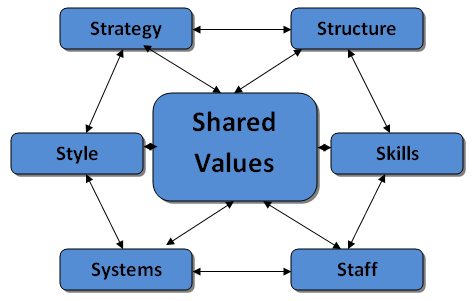
What Is the McKinsey 7S Model? Key Terms McKinsey 7S Model An organisational effectiveness framework developed by Tom Peters and Robert Waterman at McKinsey & Company in the 1980s (and further elaborated in their book In Search of Excellence, 1982). The model proposes that seven interdependent elements must be aligned for an organisation to operate…

Read More

Change Management Models: Lewin, EASIER, Kotter and When to Use Each

March 7, 2016Lee Candy

What Are Change Management Models? Key Terms Change Management Models Structured frameworks that guide organisations through planned transitions — helping leaders and teams navigate the psychological, cultural, and operational dimensions of change in a sequenced, evidence-based way. They exist because organisational change has a well-documented failure rate: McKinsey research finds that 70% of transformation initiatives…

Read More

Posts pagination

<1234…7>

Follow Us

Twitter

Educational Business Articles provides free, practical guides on leadership, management, lean manufacturing, change management and problem solving used by managers, students and trainers worldwide.

Leadership  |  Problem Solving  |  Change Management  |  Lean Manufacturing

  • Home
  • About Us
  • Free Guides
  • Blog
  • Contact Us
  • Privacy Policy
Copyright © 2026 Educational-Business-Articles.com | All rights reserved.