
What Is Lean Culture?
Key Terms
- Lean Culture
- The set of shared values, behaviours, habits, and leadership practices that make continuous improvement the natural, daily way of working — rather than a project or initiative. In a true Lean culture, improvement is not something done periodically by specialists; it is something everyone does, every day, as a fundamental part of their role.
The majority of Lean implementations produce impressive initial results followed by regression. The tools work — 5S delivers organised workplaces, Kaizen events produce measurable improvements — but within 12–18 months, the workplace looks as it did before. The reason is almost always cultural: tools were implemented but culture was not changed. Without the values, habits, and leadership behaviours that sustain continuous improvement, tools are temporary events.
The Cultural Foundations of Sustainable Lean
| Foundation | What It Requires | Leadership Action |
|---|---|---|
| Respect for People | Frontline workers seen as experts in their own processes; their ideas actively sought | Daily Gemba walks; acting on suggestions; eliminating blame culture |
| Problem-solving as default | When abnormalities occur, teams stop and investigate — not workaround and continue | Stop-the-line authority; celebrating problem identification, not just resolution |
| Standard work discipline | The current best method is documented, followed, and then improved | Audit adherence; model standard work yourself; reward improvement, not deviation |
| Visual management | Process status, performance, and problems are instantly visible without asking | Implement and maintain visual controls; use them in daily team reviews |
Explore the Full Lean and Continuous Improvement Toolkit
- ►Lean Manufacturing: Definition and 5 Principles
- ►Plan Do Check Act: The Improvement Cycle
- ►The 7 Wastes: Identifying and Eliminating Muda
- ►TQM Tools: Quality Management Toolkit
The following section contains our original guide.
When creating a Lean Culture, most Lean Practitioners often describe it as the use of Lean Tools’. – ‘What you do’.
The problem is, that a successful lean implementation, which focuses on a Rapid ‘Kaizen’ can have dramatic improvements at first, but often falls down later. – Picture an implementation of a new Cell: It flows to Takt, there is minimum Process Waste , and the place looks immaculate. From this improvement project, there were real productivity gains of 50% and a reduction of 75% in Inventory in the area!
I would bet my bottom dollar that a year later, if you returned, the cell would not be as good as it was – inventory has built up, processes not adhered to, 5S looking a bit shabby in places, etc, etc.
Focus on the Tools and the People
The reason – Focusing purely on Tools – ‘the What’ in isolation means that you are not addressing the larger factor of creating a Lean Culture – ‘the how’. In fact culture is about ‘how we do things around here,’ not what we do.
By tackling and embracing Lean Tools, I would argue that you address 20% of Lean – the good and pretty stuff.
The 80% is the Cultural side – changing habits, ways of working, and belief systems. This takes time, hard work and a lot of tears.
Creating a Lean Culture is about getting everyone to see and embrace Lean; to see waste and remove it; to question everything they do; to act only on fact and not opinion, and work together, not in silos.
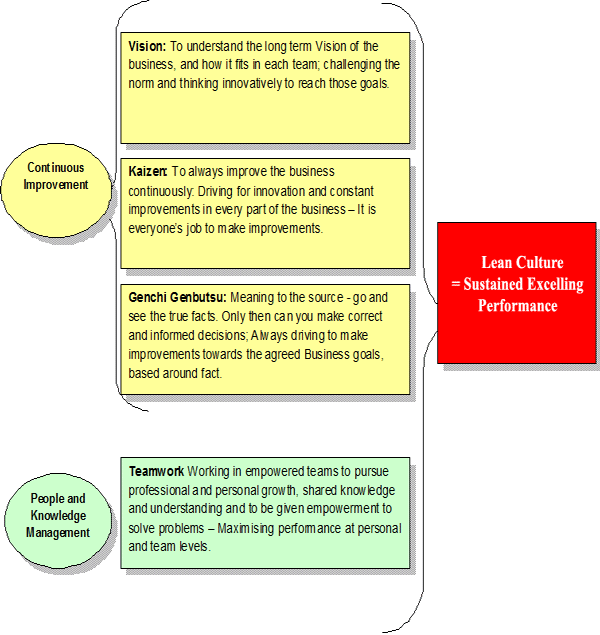
Embedding Lean Culture, therefore, is more than just what we do, but how we do it, how we go about our activities, inline with the corporate goals, addressing the need to constantly pursue improvements in individuals (Training and development), but also for the company (Waste removal and innovation).
Old habits die hard
It is Management and Leadership’s responsibility to constantly drive the same message, involve everyone and to guide this change. They must ensure that the new ways of working are being embedded, through Leader Standard Work, Coaching, facilitating, regular communication, and absolutely clear Roles and Responsibilities of everyone.
– Never letting old habits slip back, through constant reinforcement of the new vision, the new philosophies and Leading by example, acting as true Change Agents.
A true lean transformation must begin with the people. Serious lean leaders must be identified… those that can positively drive and communicate disgust for waste in everything they do… and empowered to make quick changes. But just as importantly the other employees have to also be brought into the fold.
They need to be trained on how to recognise waste, how to use the tools to drill down to the underlying causes of waste, and how to get rid of it. – Not to be Leaned by someone, but to do it themselves.
The Road is Long!
Changing to a true Lean Culture isn’t a quick fix; it is a new way of life, and can take years to perfect. Most companies that say they have a Lean Culture, in reality are still years away to a true Lean Culture.
The secret is to reinforce new ways of working, new systems, and new ways of thinking, to address the ‘How’ – HOW we go about things, the attitude and the mindset by which we do things are of utmost importance, and only then can this start to become embedded in a true Lean sense.