
What Are Motivation Theories and Why Do They Matter?
Key Terms
- Motivation Theories
- Frameworks developed by researchers and organisational psychologists to explain the psychological processes that energise, direct, and sustain human behaviour at work. They answer a question every manager faces daily: what drives people to perform at their best — and what causes them to disengage?
Gallup’s 2023 State of the Global Workplace report found that only 23% of employees worldwide are actively engaged at work — meaning 77% are either not engaged or actively disengaged. The annual economic cost of this disengagement is estimated at $8.8 trillion. Understanding motivation theories is not an academic exercise; it is one of the highest-leverage management capabilities available.
How Do the Key Motivation Theories Compare?
| Theory | Author | Core Insight | Manager Application |
|---|---|---|---|
| Hierarchy of Needs | Maslow (1943) | People fulfil needs in sequence: physiological → safety → belonging → esteem → self-actualisation | Diagnose which level a team member is at before applying motivators |
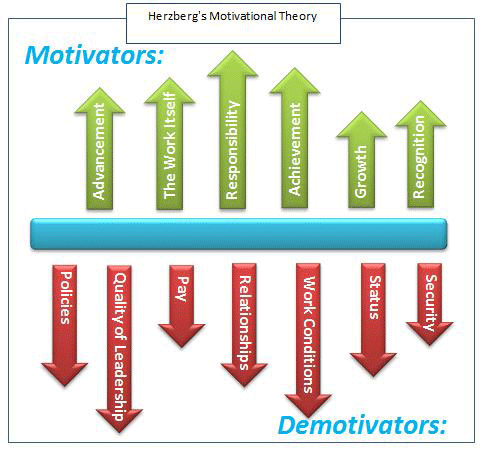
| Two-Factor Theory | Herzberg (1959) | Hygiene factors (pay, conditions) prevent dissatisfaction; motivators (achievement, recognition) create engagement | Fix hygiene factors first, then invest in motivators |
| Need Theory | McClelland (1961) | Individuals are primarily driven by nAch (achievement), nPow (power), or nAff (affiliation) | Match tasks and rewards to dominant need profile |
| Expectancy Theory | Vroom (1964) | Motivation = Expectancy × Instrumentality × Valence | Ensure people believe effort leads to performance and performance leads to valued rewards |
| Self-Determination Theory | Deci & Ryan (1985) | Intrinsic motivation requires Autonomy, Competence, and Relatedness | Give people ownership, growth, and connection to team purpose |
Which Motivation Theory Should You Use?
No single theory captures the full complexity of human motivation. The most effective managers treat these frameworks as complementary lenses:
- ►Use Herzberg when diagnosing why a previously engaged employee has become disengaged — are hygiene factors (pay, workload, management) the problem?
- ►Use Maslow when a team is going through significant change (job security concerns move people down the hierarchy)
- ►Use Vroom when setting targets — if the goal feels unachievable (low expectancy) or the reward feels irrelevant (low valence), motivation will be low regardless of effort
- ►Use Self-Determination Theory as your daily operating framework for building sustainable engagement through autonomy, growth, and purpose
Related Motivation and Leadership Resources
- ►Non-Monetary Ways to Reward Employees
- ►Emotional Intelligence: Understanding What Drives Your Team
- ►Six Leadership Styles: Matching Approach to Team Need
- ►Providing Great Feedback: A Practical Guide
- ►Setting SMART Goals: Channelling Motivation into Results
🔗 Related: How to Improve Employee Engagement: Applying Motivation Theory
🔗 Related: Delegation and Empowerment: Autonomy as a Core Motivator
The following section contains our original detailed guide to the key motivation theories.
Many different motivation theories have been created and dissected over the past century in an attempt to understand human behaviour and answer the question: “what creates the force needed to do things we want to do?”Wikipedia defines motivation as, “The general desire or willingness of someone to do something.” Motivation is a need within us that inspires us to take action. In leadership, motivation theories play a key part in organisational behaviour and creating team success. It forms the centre of influence and therefore effective and inspirational leadership.
To be in a position to motivate your people, first you must understand what actually motivates them in the first place; what makes them tick and what inspires them.
As stated in other articles, the large misconception is that most people come to work just for the money; however, if you delve deeper into the psyche of people and the many supporting motivation theories, you would find that this is far from the truth.
Some quick examples of other factors that can motivate people are:
- ►Recognition of ability
- ►Sense of achievement
- ►Learning and growth
- ►Stimulating work
- ►Responsibility and empowerment
- ►Promotion
- ►Feeling of being a part of something
Due to the complexity of humans and the associated aspect of motivation, many gurus over the years have created a number of motivation theories to try to identify and understand the factors that influence our enthusiasm levels, and therefore our driving force behind our actions. The following are the key theories that have been created over the past century.
The Main Motivation Theories
Maslow’s Hierarchy of Needs was created by Abraham Maslow in the 1940s. He attempted to create reasoning among different motivation levels, stating that motivational needs range from the basic physiological needs like air, food etc to self-fulfilment, like helping others and growing as a person. He identified that our motivational factors influence what we are aspiring for and are in sequential order. Therefore, if you are struggling to find food, then your motivation is to find food and sustain it. You wouldn’t at this point, be concerned with growth and bettering yourself as an individual, but as each need is met, the desire to grow and develop is evident, towards the level 5 need of understanding your worth and true potential.
Herzberg’s Hygiene model – The next of the major motivation theories, Herzberg argues that there are two main factors that people take into consideration when they are motivated. Herzberg’s Motivation-Hygiene Theory (sometimes known as Herzberg’s Two Factor Theory.) , directly attempted to answer the question, “How do You Motivate Employees?” The conclusions he drew were extraordinarily influential, and still form the bedrock of good motivational practice nearly half a century later.
His findings revealed that certain characteristics of a job are consistently related to job satisfaction, while different factors are associated with job dissatisfaction. The goal of this theory is to do two things:
1. Eliminate the factors of dissatisfaction (the term Herzberg uses as hygiene factors) – which include things like:
- ►Fixing poor and obstructive company policies.
- ►Providing effective, supportive and non-intrusive supervision. .
- ►Creating and supporting a culture of respect and dignity for all team members. .
- ►Ensuring that wages are competitive, and so on.
2. Create conditions for job satisfaction – Herzberg referred to this as job enrichment, and aims to provide more satisfaction in each individual’s jobs. Typical areas to improve are:
- ►Providing opportunities for achievement. .
- ►Recognising workers’ contributions. .
- ►Giving as much responsibility to each team member as possible. .
- ►Providing opportunities to advance in the company through internal promotions. .
McGregor’s Theory X, Theory Y Model is another of the key contributors to motivation theories. His theory states that there are two ways of managing and motivating individuals.
McGregor’s ideas suggest that many managers tend towards theory x, and generally get poor results. On the contrary, enlightened and successful managers use theory y, which produces better performance and results, and allows people to grow and develop in their roles.
McGregor’s ideas significantly relate to modern understanding of the Psychological Contract, which identifies that there are many ways to understand the unhelpful nature of x-theory management and the positive benefits of the y-theory alternative.
Theory x (‘authoritarian management’ style) –Associated with the following typical points:
- ►The average person dislikes work and will avoid it if he/she can.
- ►Therefore most people must be forced with the threat of punishment to work towards organisational objectives.
- ►The average person prefers to be directed; to avoid responsibility; is relatively unambitious, and wants security above all else.
Theory y (‘participative management’ style) – Associated with the following points:
- ►Effort in work is as natural as work and play.
- ►People will apply self-control and self-direction in the pursuit of organisational objectives, without external control or the threat of punishment.
- ►Commitment to objectives is a function of rewards associated with their achievement.
- ►People usually accept and often seek responsibility.
- ►The capacity to use a high degree of imagination, ingenuity and creativity in solving organisational problems is widely, not narrowly, distributed in the population.
- ►In industry the intellectual potential of the average person is only partly utilised.
Victor Vroom’s Expectancy Theory – The fourth contributor to motivation theories, Vroom’s Expectancy Theory was developed in 1964, and demonstrates a link between expected results and reward, which follows a similar path to Transactional Leadership. The motivational levels that Vroom suggests are based on how hard an employee wants an outcome. If they want it enough, they will put the effort in to achieve it.
In this sense, managers must find ways to provide achievable goals that inspire the team members, whilst linking the appropriate rewards to those goals.
Motivational Guidelines
There are many ways a leader can motivate and inspire their people. The nine most common methods that have been proven to work are:
- ►Show confidence in each person
- ►Encourage a ‘take charge’ attitude, whereby people make things happen
- ►Encourage involvement and empowerment with each person
- ►Give credit and praise to each individual that deserves it
- ►Foster team work and encourage a togetherness
- ►Help to build pride in individual’s contributions
- ►Encourage team work and for each person to help each other
- ►Provide opportunities for everyone to learn new skills and abilities
- ►Lead and personally contribute to the development of each person
Common Workplace Demotivating Factors
In tandem with the motivational guidelines, there are common factors to avoid when trying to inspire and motivate people. These common pointers span across any of the motivation theories you may prefer to use, and again, are tried and tested pointers to avoid when leading your teams.
- ►Poor personal engagement with individuals
- ►Poor communication – lack of regular reviews, both on a team level and one-to-ones
- ►Lack of clear goals and direction – What constitutes success to each individual? Do they know how they contribute to the company’s objectives?
- ►Uninteresting work – Employees that are not being stimulated and developing can be demotivated. The trick here is to empower individuals and enlarge their roles to create variability and growth.
- ►Poor Feedback and failure to recognise achievement
Understand Your Team – Using Motivation Theories
Apply the simple steps below to help inspire, motivate and influence your team to success.
- ►With your team, start to think about the general motivation guidelines and the nine principles of good motivation (above). Highlight those that are not evident or weak in evidence.
- ►Put a plan together, complete with actions and timescales, to include these factors into your team and leadership practices.
- ►Now look at the key demotivating factors above, and highlight those that are evident in your team.
- ►Add tasks to the action plan, to begin to eliminate these demotivating factors.
- ►Now start to think of additional ways you can motivate, inspire and reward members of your team – think of three additional ideas.
- ►Add two additional de-motivating factors that you can see in your team and add these to the action plan.
- ►Now score each factor and associated action in priority order.
- ►Tackle the first three highest priority actions first and complete them.
- ►Then tackle the next three actions, and so on until the action plan has been completed.
- ►Monitor your results. Do the team members feel more engaged and motivated?
- ►If not, return to the above steps and go again.
- ►If they do, continue to conduct one-to-one reviews and maintain your leadership practices, whilst always looking for new ways to keep your team inspired.