
What Are the 7 Wastes of Lean?
Key Terms
- The 7 Wastes (Muda)
- Seven categories of non-value-adding activity identified by Taiichi Ohno within the Toyota Production System. “Muda” (無駄) is the Japanese term for futility or wastefulnes. Ohno argued that all waste in a production system falls into one of seven types — and that systematically eliminating these wastes is the primary path to improving quality, reducing cost, and shortening lead time simultaneously.
The original 7 Wastes framework was later extended to 8 Wastes (adding “Skills” — the underutilisation of human talent) in most modern Lean applications. Both frameworks remain in active use; the 7-waste version is most common in manufacturing contexts, while the 8-waste (TIMWOODS) framework is widely used in service and transactional environments.
The 7 Wastes: Definitions and Examples
| Waste | Definition | Manufacturing Example | Service/Office Example |
|---|---|---|---|
| 1. Transport | Moving materials or information more than necessary | Moving parts between distant workstations | Emailing documents between departments instead of shared access |
| 2. Inventory | Excess stock held beyond immediate need | Raw material buffer exceeding 2 days’ supply | Unprocessed paperwork queue building up |
| 3. Motion | Unnecessary movement by people | Reaching across workstation for tools not at point of use | Walking to a shared printer across the building |
| 4. Waiting | Idle time when the next step is not ready | Machine idle while waiting for materials or repair | Waiting for approval from a manager who is unavailable |
| 5. Overproduction | Making more than the customer needs, sooner than needed | Producing batch of 500 when customer needs 50 | Generating reports nobody reads |
| 6. Over-processing | Doing more work than the customer requires | Polishing a surface the customer never sees | Multiple approval layers for low-risk decisions |
| 7. Defects | Products or services requiring rework or correction | Scrap rate; warranty claims | Data entry errors; incorrect invoices |
How to Identify Waste in Your Process
- ►Walk the process (Genchi Genbutsu — “go and see”): observe the actual process in action, timed and documented, rather than relying on procedure documents
- ►Map the value stream: create a visual map of every step; non-value-adding steps are waste candidates
- ►Ask “would the customer pay for this step?” If no — it is waste
Related Lean Resources
- ►Lean Manufacturing: Definition and 5 Principles
- ►Plan Do Check Act: Eliminating Waste Systematically
- ►Process Flow Charts: Mapping Where Waste Occurs
- ►TQM Tools: Measuring and Monitoring Quality
The following section contains our original guide to identifying the 7 wastes in your business.
Understanding the 7 wastes allows you to be able to identify process waste, whether it be in a Manufacturing or Service business. If you can see it, you can eliminate it and therefore increase your efficiency, productivity and profit levels.
I think this is one of the most important aspects of Lean manufacturing. If you can see it and feel it, and more importantly, feel uncomfortable around waste, then you get it!
That’s what my old mentor would say, and he is right – if you can get ‘it’, it means you understand ‘it’ – if you understand ‘it’, then you can eliminate it!
Let’s have a look at what the wastes are, but first a definition.
NVA & VA
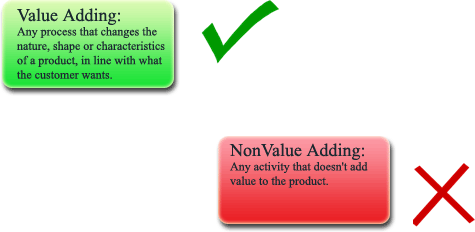
Specifically, the 7 wastes we are talking about refer to process waste. The Japanese refer to this as Muda. Every activity that is conducted in a business is either Value Add (VA) or Non Value Add (NVA).
Value Add activities are all those activities which physically transform a product or service in the eyes of the customer – activities that actually add value!
Non Value Add activities are all those activities which are conducted, that do not add value. Some may be essential and may be a necessity in order to do the job, but are still NVA, which encompass the 7 wastes – All NVA cost is carried by the company.
An Example
Let’s look at NVA and VA in a simple value stream below.
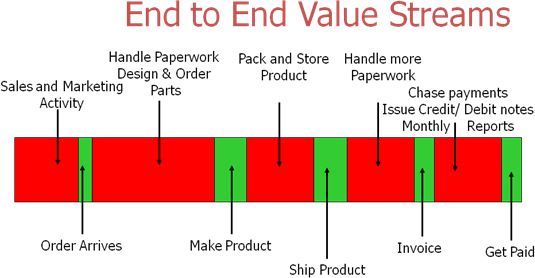
The above diagram demonstrates NVA in red and VA in green.
The aim is to remove as much NVA as possible. Obviously, some activities have to be completed, but with all tasks, it is essential to ask how you can reduce those ‘must do’ NVA tasks to a minimum.
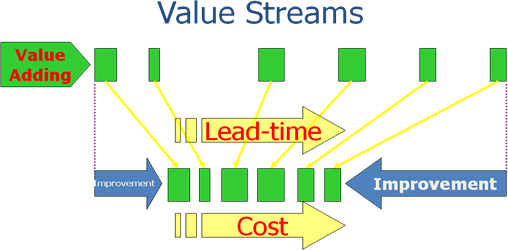
The ultimate goal is to take all NVA out (which will never be achieved, but must still be a goal in pursuit of continuous improvement). Any waste removal or reduction will result in shortened Lead Times:
The 7 Wastes in Detail
The 7 wastes are Non Value Add and must be seen as the enemy. They absorb time, and cost.
The way to remember them is to think of Tim Wood. This guy is in every business, and it is your responsibility to hunt him down and reduce and eliminate as best you can. He absorbs costs, overheads, and cash in the business.
So here is TIM WOOD!
T – Transport
I – Inventory
M – Movement
W – Waiting and delays
O – Over production
O – Over Processing
D – Defects
Transport
Transportation of product and work in progress is necessary, but it must be controlled in terms of times and distance. Each turn a product is moved, it stands the risk of being damaged, lost, delayed, and so on. More critically, the longer a product moves around, the longer there is no Value being added to it, as it is not being physically transformed. Transportation does not make any transformation to the product that the consumer is supposed to pay for.
Inventory
Producing something to sit around and wait for the next process, which doesn’t start straight away is NVA. The product is waiting and not adding value sitting on a job rack somewhere. The problem is, the more inventory the worse it is, as this can be in the form of Work in progress, raw material or finished goods.
The point is: in any of these three forms of inventory, if it hasn’t been sold, it is cash that has been tied up into the material, which the customer hasn’t bought yet– These result in a massive drain on the cash flow!
Movement
Similar to transportation, but movement refers to movement of operator and equipment. Again, think of the fact that operators moving around, searching and finding things cannot be adding value. Same too with equipment – if you are spending time lumping equipment around, you cannot be using it to add value and make money, plus the chances of damage increases.
Waiting and Delays
When work in progress and goods are not being worked on, they sit there waiting – waiting for the next process. This is typical of traditional ‘Batch and Queue’ methods. Waiting means that product is costing the company money and not adding value.
Over production
The worst of the 7 wastes – as it incorporates all the other wastes as well. Over production appears when processes are not efficient. If Changeovers are too slow, one would over produce; if quality if poor, again, one would over produce, just in case. The problem is, “the customer may want 10 parts, for instance, but we will produce 20 parts and store them…….”
The difficulty is that valuable time and energy has gone into producing parts that are sitting around consuming space in stores, whereby someone has to spend time processing them and stock counting, and the customer hasn’t even bought them – All at a cost to the company!
Over processing
If you don’t know exactly what the customer wants, how can you align your processes to what the customer needs? Over processing is about completing work for the customer, which is more than the customer really wants. Think of mowing your lawn – would you cut each blade of grass with a pair of scissors and then measure it with a rule? Of course not -Mowing the lawn with the mower is sufficient.
Another example – A company i used to work for used to print mobile phone key pads. The customer wanted blemish free (looking at it with the naked eye) key pads, but our inspectors would view each part with an eye glass of 14 times magnification! Any slight imperfection in an eyeglass meant that the part was rejected, when in fact in clear light and with the naked eye, they were perfect!
It probably comes as no surprise that the company were wasting time in rework, over inspection, and rejects alone were over £500,000 per year on a product that turned over £3million per year!
Defects
You can’t add value twice! If you scrap a complete job, you wouldn’t go to your customer and ask for an extra £5000 (or what ever the cost is!) to reprocess a job that you couldn’t do right first time! Your customer would think you are mad and go elsewhere!
Every bit of scrap costs money and time – Money for the resource to pay staff, lighting, etc to do it again, but also means that you have to push another planned job back in the queue in order to get the rework out! It’s all cost and less cash for the business.
Now your turn!
By keeping the 7 wastes in mind, and more importantly, Tim Wood, try standing on the shop floor of your office or manufacturing plant for ten minutes, and note down how many times you see each of the 7 wastes in that ten minute window.
Record the evidence on a note pad and then review the results.It is quite amazing to see just how much waste there is in every process.
Once you have found each of the 7 wastes, spend time with the team and ask the following:
- ►Can you eliminate it?
- ►If no, can you reduce the NVA time?
- ►If no, can you combine NVA activities together?
Keep on the hunt for Tim Wood and let me know your
findings…………………..