
What Is Transformational Leadership?
Key Terms
- Transformational Leadership
- A leadership theory, first introduced by political sociologist James MacGregor Burns in 1978 and later extended by Bernard Bass (1985), that describes leaders who inspire followers to exceed their own self-interest for the good of the organisation — raising followers’ levels of motivation, morality, and performance by appealing to higher-order values, vision, and meaning rather than transactional rewards.
Transformational leadership represents a fundamental shift in how leadership is understood. Earlier theories focused primarily on the leader’s traits or the mechanical exchange of reward for performance. Burns and Bass proposed something more profound: that the most powerful leaders do not just manage people — they transform them. They change how followers see themselves, what they believe is possible, and what they are willing to commit to.
Meta-analytic research by Judge and Piccolo (2004), drawing on over 87 studies, found transformational leadership to be positively correlated with follower satisfaction, motivation, and effectiveness across cultures, industries, and organisational levels — making it one of the most empirically validated leadership theories in the academic literature.
What Are the Four I’s of Transformational Leadership?
Bernard Bass operationalised transformational leadership into four core behavioural dimensions, known as the Four I’s:
1. Idealised Influence (Attributed and Behavioural)
The transformational leader acts as a role model — someone followers admire, trust, and seek to emulate. They demonstrate high ethical standards, place the needs of others before their own, and take personal responsibility for outcomes. Followers attribute charisma and a sense of mission to these leaders.
In practice: You are consistent between what you say and what you do. You sacrifice personal comfort for team benefit. You are seen as someone worth following, not simply someone with authority.
2. Inspirational Motivation
The leader articulates a compelling, optimistic vision of the future that provides meaning and challenge to followers. They communicate high expectations clearly and use symbols, stories, and metaphors to make the vision emotionally resonant as well as intellectually clear.
In practice: Your team understands not just what they are doing, but why it matters. People can connect their daily work to a larger purpose. The vision pulls performance upward rather than rules pushing it forward.
3. Intellectual Stimulation
The leader challenges followers to question assumptions, think creatively, and approach problems from new angles. They create psychological safety for unconventional thinking and do not ridicule or criticise ideas publicly. Mistakes are treated as learning opportunities.
In practice: Your team brings you problems and ideas rather than hiding them. People experiment and innovate without fear of punishment for failure. Conventional wisdom is regularly questioned constructively.
4. Individualised Consideration
The leader treats each follower as an individual with unique needs, strengths, and developmental aspirations. They act as mentors and coaches, delegate purposefully to develop capability, and listen actively to individual concerns.
In practice: You know what motivates each person on your team, what their career goals are, and where their development gaps lie. One-to-one conversations are substantive, not performative.
Transformational vs. Transactional Leadership
Burns’ original contribution was to contrast transformational leadership with what he called transactional leadership — a leadership approach based on exchange: the leader provides rewards (pay, recognition, promotion) in return for performance, and applies corrective action when standards are not met.
| Dimension | Transactional | Transformational |
|---|---|---|
| Motivation mechanism | Rewards and penalties | Shared vision and values |
| Leader–follower relationship | Exchange (contractual) | Transformative (developmental) |
| Goal orientation | Existing goals, current standards | Elevated goals, new possibilities |
| Change stance | Maintains stability | Drives and embraces change |
| Effect on followers | Compliance | Commitment and growth |
| Best context | Stable, well-defined processes | Change, innovation, transformation |
Important nuance: Bass’ later research found that the most effective leaders use both styles — transactional as a foundation (clear expectations, fair rewards) and transformational as the differentiating layer that lifts performance above baseline. Neither approach alone is sufficient.
What Are the Criticisms of Transformational Leadership?
- ►Risk of hero-worship — Idealised Influence can create unhealthy dependency on the leader, reducing team resilience and autonomous decision-making.
- ►Potential for manipulation — The inspirational tools of TL — vision, charisma, emotional appeal — can be used to pursue unethical ends. Burns explicitly distinguished “pseudo-transformational” leaders (who transform followers for self-serving ends) from authentic transformational leaders.
- ►Measurement challenges — The Multifactor Leadership Questionnaire (MLQ), the most common TL assessment tool, has faced validity criticisms, particularly around the distinction between Idealised Influence and Inspirational Motivation.
- ►Impractical for all contexts — In highly regulated, safety-critical, or highly routine environments, transactional clarity may be more valuable than inspirational vision.
How to Develop Transformational Leadership Behaviours
- ►Clarify and articulate your vision — Before you can inspire others, you must be able to state clearly where you are going and why it matters. Write a one-paragraph vision statement for your team.
- ►Model the behaviours you expect — Identify the 3–5 behaviours that most define your team’s culture. Demonstrate them consistently, especially under pressure.
- ►Build individual relationships — Schedule regular one-to-ones focused on the person’s development, not just task updates. Ask about goals, challenges, and what support they need.
- ►Create space for intellectual challenge — Ask “What if we tried a completely different approach?” Respond to unconventional ideas with curiosity, not immediate evaluation.
- ►Connect work to meaning — Regularly help your team see how their work contributes to something larger than the immediate task — customer impact, organisational mission, professional growth.
Related Leadership Resources
- ►Six Leadership Styles: Goleman’s Complete Framework
- ►Situational Leadership: Matching Style to Team Readiness
- ►Emotional Intelligence Theory: Core Leadership Competency
- ►Authoritarian Leadership: When and How to Use It
- ►Providing Great Feedback: A Practical Framework
🔗 Related: Effective Leadership Styles: Choosing the Right Approach
The following section contains our original overview of the Transformational Leadership model.
Much of modern day leadership thinking is based around the theory of transformational leadership, of which MacGregor Burns first introduced this concept in 1978, in his book called, ‘Leadership’.
Burns was one of the first gurus to identify that true leadership not only creates change and achieves goals within his or her environment, but changes the people and their actions for the better as well.
Imagine a time in your life, when you have been truly inspired by your boss. Perhaps you felt happy to follow his or her lead? You probably felt that the ambiance was perfect and you were empowered to learn and try new things.
Transformational leadership often provides the right make up to allow a team to flourish. It effectively takes all the leadership styles developed over the years and combines them to form one leadership theory that encapsulates leading through inspiring.
A New Dimension
Transformational Leadership was the first theory to provide an ethical and moral dimension to leadership and focuses on three main ways in which leaders transform followers:
- ►Increasing their awareness of task importance and value.
- ►Getting them to focus first on the team goals, rather than on their own interests.
- ►Activating their higher-order needs and truly motivating to success.
The Transformational Leader seeks to lead and drive change for the better within their teams, through leading by example; inspiring others to achieve great things; creating buy-in and motivation through self-actualisation and creating deep rooted relationships on an individual basis.
Transformational leadership also allows people to find their selves and promote leadership within the team setting, through empowerment and coaching.
Thus, the great leaders create succession planning by developing people and allowing them to take the initiative.
The Transformational Leadership Model
There are arguably a number of attributes and behaviours that exhibit a true transformational leader. These can be seen in the model below:
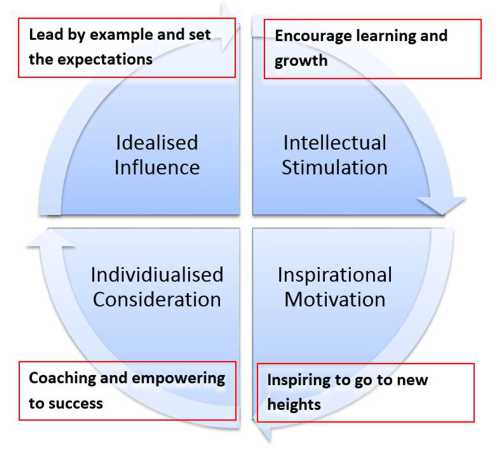
Idealised Influence –The leader acts as a role model that his / her followers seek to emulate. Through the use of demonstrating the right behaviours, they win trust and respect from their team. They also on numerous occasions, place the needs of their team and individuals first, working in an ethical and moral way. The use of power for transformational leaders is used more to influence others to achieve the team’s and their own goals.
Intellectual Stimulation – Encouraging and facilitating learning for each member of the team. This learning is more ‘learn by doing’, whereby transformational leadership encourages followers to be innovative, creative and solve problems. The team benefit through the principles of continuous improvement and trial and error, thus expanding their knowledge as they progress. They encourage new ideas from their followers and never criticise them publicly for mistakes made: the leaders focus on the “what” in problems and do not focus on finger pointing. They also easily discard an old practice set by them if it is found ineffective, in true continuous improvement style and encourage new ideas and growth through learning.
Inspirational Motivation – The aim is not punish or tell someone to do something, but inspire them to challenge the status quo. Transformational leaders guide followers by providing them with a sense of meaning and a degree of challenge. They work ardently to foster the spirit of teamwork and commitment and clearly communicate the way forward, its vision, and the objectives that the team needs to achieve. People are bought in to the idea and are brought along with the leader.
Individualised Consideration – The role of the leader here is to act as a coach and mentor, facilitating improvements, ownership, learning and empowerment. Leaders act as mentors to their followers and reward them for creativity and innovation. Team members are treated according to their skills and knowledge and in much the same way as Situational Leadership would suggest; led depending on their task ability and willingness.
People are empowered to make decisions and take on tasks that enable them to learn and develop. The leader in this respect, focuses on ensuring support is given to allow the person to succeed.
To surmise:
Think of a transformational leader as one whom:
- ►Leads people to situations that they have never experienced
- ►Gets people excited about the future and experiencing these new situations
- ►Enables the team to act and learn by doing through coaching and support
- ►Sets the example and leads the way
- ►Builds deep relationships on effective communication, integrity and respect
How to use the Model
- ►Be inspired in your heart and mind, and show it with your team. Set a goal and believe in that goal – communicate it with everyone and get people thinking about it.
- ►Be connected to yourself and the people around you. Be grounded in reality and understand your own values and beliefs. Learn the skill of emotional intelligence and use it to engage with your team.
- ►Encourage others to seek understanding themselves. Use tools like the Johari Window, Belbin Team Roles, and also Myers Briggs to help understand individual strengths and weaknesses. Use this insight to encourage development.
- ►Have a vision and communicate it with passion and purpose. Allow this passion and energy to inspire and motivate your team. Try to include your team in the development of goals and agree to objectives.
- ►Genuinely show interest and care about your team members. Take time to understand what they want, and how you can serve their interests.
- ►Be curious, open to new ideas and learn constantly. Use the principles of continuous improvement with your team members and encourage learning.
- ►Learn to coach the team and drive empowerment . Follow the steps of Flexible leadership and drive autonomy and development in tasks.