
What Is the Trait Theory of Leadership?
Key Terms
- Trait Theory of Leadership
- One of the earliest systematic approaches to understanding leadership, which proposes that effective leaders possess a distinct set of stable personal characteristics — such as intelligence, confidence, integrity, and drive — that differentiate them from non-leaders. The theory attempts to identify who leaders are by their inherent qualities, rather than what leaders do.
The Trait Theory of Leadership has its roots in the 19th-century “Great Man Theory” — the idea, popularised by historian Thomas Carlyle, that history is shaped by the actions of exceptional individuals who are born with innate qualities of greatness. The implication was that leadership was a natural gift, not a learnable skill: you either had it or you did not.
By the early 20th century, academic researchers began applying more rigorous methods to this intuition, attempting to identify the specific traits that distinguished great leaders from their followers. Stogdill’s landmark reviews of leadership trait research (1948 and 1974) analysed hundreds of studies and identified clusters of traits consistently associated with leadership effectiveness, though his work also revealed important limitations that led to a significant evolution in leadership theory.
What Are the Key Leadership Traits? (The Research Evidence)
Across decades of research, a consistent set of traits emerges as predictive of leadership emergence and effectiveness. These can be grouped into five core categories:
Intelligence and Cognitive Capacity
Early research consistently identified above-average intelligence as a predictor of leadership. More specifically, it is the ability to process complex information, make sound judgements under pressure, and communicate clearly that matters — not raw IQ. Leaders who are significantly more intelligent than their followers can actually experience reduced effectiveness if the gap creates a communication barrier.
Personality: The Big Five Connection
Modern trait research has largely converged on the Big Five personality model (OCEAN) as the most reliable framework for understanding leadership-relevant traits:
- ►Openness to Experience — Associated with creative thinking, adaptability, and intellectual curiosity. Strongly linked to transformational leadership.
- ►Conscientiousness — The strongest single predictor of leadership effectiveness. Includes persistence, reliability, organisation, and goal-directedness.
- ►Extraversion — Positively correlated with leadership emergence (extroverts are more likely to be seen as leaders) but less strongly linked to leadership effectiveness.
- ►Agreeableness — Linked to affiliative and collaborative leadership behaviours; less strongly linked to authoritative or directive styles.
- ►Neuroticism (low) — Emotional stability is consistently associated with effective leadership. Leaders with high neuroticism tend to respond poorly under pressure.
Self-Confidence and Decisiveness
Leaders who believe in their own ability to make a difference — what psychologists call self-efficacy — set higher goals, persist longer in the face of setbacks, and inspire confidence in others. Decisiveness under ambiguity is a closely related trait: the ability to commit to a course of action even when information is incomplete.
Integrity and Trustworthiness
Research consistently identifies integrity — the alignment between stated values and actual behaviour — as a foundational leadership trait. Teams led by individuals perceived as honest and trustworthy demonstrate higher engagement, greater willingness to take initiative, and lower turnover. This is not merely an ethical point; it is a performance driver.
Drive and Achievement Motivation
High-achieving leaders tend to demonstrate a strong internal drive: ambition, initiative, energy, and persistence. They pursue goals for intrinsic reasons (the challenge and sense of accomplishment) rather than primarily for external rewards. This aligns closely with McClelland’s concept of need for achievement (nAch).
What Are the Strengths of Trait Theory?
- ►Intuitive and accessible — It provides a straightforward language for discussing leadership qualities that resonates with practitioners.
- ►Supports talent identification — Trait-based assessments (psychometric tests, structured interviews) help organisations identify high-potential individuals at an early stage.
- ►Strong evidence base — Meta-analyses confirm that certain traits (especially conscientiousness and emotional stability) do predict leadership effectiveness across cultures and contexts.
- ►Developmental value — Even if some traits have a genetic basis, most can be developed through deliberate practice, coaching, and feedback.
What Are the Criticisms of Trait Theory?
- ►Ignores context — The same traits do not produce effective leadership in all situations. A highly directive, confident leader may thrive in a crisis and fail catastrophically in a collaborative innovation environment.
- ►Inconsistent trait lists — Early research produced hundreds of different traits with limited consensus, suggesting the approach lacked scientific rigour.
- ►Correlation vs. causation — Many trait studies identify characteristics of existing leaders rather than proving those traits caused their success.
- ►Underestimates development — Overemphasis on innate traits can discourage investment in leadership development and create a self-fulfilling prophecy where those not identified as “natural leaders” are given fewer growth opportunities.
These criticisms led to the development of subsequent theories — Situational Leadership, Transformational Leadership, and behavioural approaches — that incorporate context and learned behaviours alongside personal characteristics.
How Does Trait Theory Apply to Modern Leadership Development?
The modern consensus is a nuanced integration: traits matter, but they are neither fixed nor sufficient. Today’s most effective leadership development programmes use trait frameworks as a starting point for self-awareness, not as a ceiling on potential.
Practically, this means:
- ►Use psychometric assessment to establish a baseline picture of natural strengths and development areas (personality inventories, 360° feedback, situational judgement tests).
- ►Identify the leadership traits most critical for the specific role, organisation, and strategic challenges ahead — not a generic universal list.
- ►Target deliberate development at the most impactful gaps. Conscientiousness can be developed through structured habits and accountability systems. Emotional stability through stress management and mindfulness practices. Openness through exposure to diverse perspectives and experiences.
- ►Combine with behavioural learning — Trait development alone is insufficient. Leaders also need to build specific behavioural skills: how to give feedback, how to handle conflict, how to communicate strategy.
Related Leadership Theory Resources
- ►Situational Leadership Theory: Adapting Style to Team Readiness
- ►The Six Leadership Styles: Goleman’s Complete Framework
- ►Transformational Leadership: Inspiring Change at Scale
- ►Emotional Intelligence Theory: Core Leadership Competency
- ►Leadership Characteristics: A Practical Self-Assessment Guide
The following section contains our original practical guide to applying Trait Theory of Leadership.
The trait theory of leadership is an early assumption that leaders are born and due to this belief, those that possess the correct qualities and traits are better suited to leadership. This theory often identifies behavioural characteristics that are common in leaders.Trait theory of leadership is one of the first academic theories of leadership and attempts to answer why some people are good leaders and others are not.
In fact the theory can be traced back to the nineteenth century, whereby a man called Thomas Carlyle used such understanding to identify the talents, skills and characteristics of men who rose to power.
The trait theory of leadership is based on the characteristics of many leaders – both successful and unsuccessful – and is used to predict leadership effectiveness. The resulting lists of traits are then compared to those of potential leaders to assess their likelihood of success or failure. Once found, the theory is that these natural leaders can then be nurtured to become great leaders.
Key Characteristics
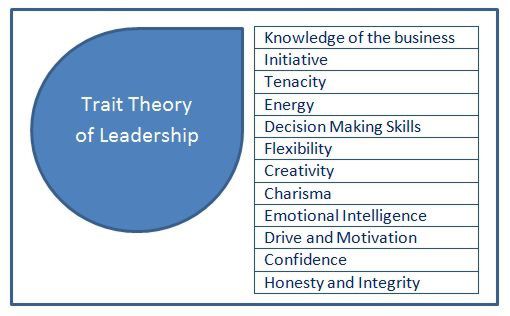
Some of the most common leadership traits identified, are:
- ►Knowledge of the business
- ►Initiative
- ►Tenacity
- ►Energy
- ►Good cognitive skills and capable of using good judgement and decisions
- ►Flexibility
- ►Creativity
- ►Charisma
- ► Emotional intelligence
- ►Drive and motivation to succeed
- ►Confidence
- ►Honesty and integrity
Traditionally, the most ardent versions of trait theory see these “leadership characteristics” as innate, and as such, some people are seen to be ‘born leaders’, due to their psychological makeup.
Proponents to this theory, which is now considered largely out of date, believe that leadership development consists of identifying and measuring leadership qualities, screening potential leaders from non-leaders, and then training those with potential.
In fact, modern thinking suggests that the above traits are little more than characteristics, which although some people can possess them naturally, can be learned, and built into one’s behaviours and thinking, thus affecting their leadership potential.
In tandem with modern day thinking, leadership is seen as a skill to be mastered and therefore, the above characteristics can all be honed. As a result, it is prudent to first understand these ‘traits’ and then develop areas of weakness, in order to become a great leader yourself.
How to Use Trait Theory of Leadership:
Step 1: Identify the typical traits of good leadership above, and start identifying where you believe your strengths and weaknesses are.
Step 2: Take the Trait Theory of Leadership Survey yourself.
Step 3: Share this survey with five other people in your team and whom know you as a leader, and get them to complete the assessment on how they perceive you as a leader.
Step 4: Submit all these findings and analyse where the gaps between how you see yourself and how others do too.
Step 5: Discuss the findings with the group and agree where you can improve.
Step 6: Develop a simple action plan of no more than 6 items to help improve your skills.