
What Is the Managerial Grid?
Key Terms
- Managerial Grid (Blake-Mouton Grid)
- A leadership behavioural model developed by Robert Blake and Jane Mouton (1964) that plots leadership style on two axes — Concern for People (vertical, 1–9) and Concern for Production/Task (horizontal, 1–9) — identifying five primary leadership styles at key intersection points. The model was one of the first to propose that the most effective leaders score high on both dimensions simultaneously.
The Five Managerial Grid Styles
| Grid Position | Style Name | Concern for People | Concern for Task | Characteristics |
|---|---|---|---|---|
| (1,1) | Impoverished Management | Low | Low | Minimum effort; does enough to avoid dismissal; disengaged |
| (9,1) | Authority-Compliance (Task) | Low | High | Results-driven; people viewed as production resources; directive |
| (1,9) | Country Club Management | High | Low | Prioritises relationships and comfort over output; avoids conflict |
| (5,5) | Middle-of-the-Road | Medium | Medium | Balances adequately but excels at neither; satisficing approach |
| (9,9) | Team Management | High | High | Integrates people and task; high trust, high performance; Blake’s ideal style |
Blake and Mouton argued that the (9,9) Team Management style is the universally superior approach — a claim that was subsequently challenged by contingency theorists who showed that situational factors also matter. In practice, the grid is most useful as a self-assessment and reflection tool rather than a prescriptive model.
How Does the Managerial Grid Relate to Other Models?
- ►The two-axis structure directly parallels Situational Leadership’s task vs. relationship dimensions
- ►The (9,9) ideal aligns with the Authoritative/Democratic styles in Goleman’s Six Styles
- ►The grid predates but conceptually overlaps with Transformational Leadership’s Individualised Consideration dimension
Related Leadership Model Resources
- ►Situational Leadership: Task vs. Relationship Balance
- ►Six Leadership Styles: Goleman’s Complete Framework
- ►Effective Leadership Styles: Choosing the Right Approach
- ►Key Leadership Theories: Historical Overview
The following section contains our original guide to the Managerial Grid.
The Managerial Grid provides a useful insight into the different leadership styles of a leader.Stop and think about it for a second; managing a business, an organisation, or a team of people requires a certain set of skills. It’s not just about understanding the financials and delivering the numbers – really good managers make clear decisions, they engage, they inspire, they connect with people.
When your manager puts you in charge of organising a project, what would you do first?
- ►Would you develop timelines and tasks and start to assign responsibility?
- ►Would you think about other people and fit this into their tasks, opting for people who can and want to do it?
What would you do if tasks start to fall behind and the plan is off track?
Would you chase everyone to get back on track, regardless of other commitments they have?
Or would you ease off, knowing that they are strained and just busy doing their jobs, let alone the extra tasks you have given them?
How you answer these questions would say a lot about your personal leadership style and what your first reaction would normally be. Some leaders are very task orientated and less people oriented and just want to get the job done, regardless of how people feel about it, whereas other people may be the complete reverse, opting for a happy camp over task effectiveness.
Other people may well be a more balanced of the two, showing a drive for task completion as well as a holding a little more emotional intelligence , thus accommodating employee needs.
The Managerial Grid
There is no right or wrong answer, per se, however, just as no one type of leadership style is best for all situations.
It is useful to understand, though, what your natural leadership tendencies are, so that you can then begin working on developing skills that you may be missing.
One of the management theories that have been recognised as providing some useful leadership style insights for businesses and organisations, is the ‘Managerial Grid’ of behavioral leadership, that was developed in the mid-60s by Robert Blake and Jane Mouton.
The way that this model assesses management effectiveness is by mapping behaviours against a grid which uses ‘concern for production’ (as the x-axis) and ‘concern for people’ (as the y-axis).
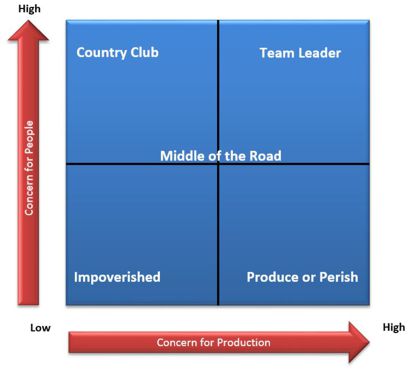
The Managerial Grid is a practical and useful framework that helps one think about their leadership style. By plotting ‘concern for production’ against ‘concern for people’, the grid highlights how placing too much emphasis in one area at the expense of the other leads to low overall productivity. The reason being, too much of one thing is not good.
The need to be balanced is essential for effective team leading. Let’s take an example:
If a manager was concerned with output, and constantly pestered and drove his team, with little interaction, empowerment, and communication, the employees would soon become disheartened and productivity and morale would suffer.
Alternatively, if another manager focused solely on a concern for her people, without direction and support, targets would not be achieved, and productivity too, would suffer.
The 5 Styles to the Managerial Grid
The five styles that this model documents are:
- ►The impoverished style – in this leadership style, managers have low concern for both people and production. Leaders use this style to preserve their job and their position – protecting themselves by avoiding getting into trouble. This characteristic of management tends to result in very low levels of innovation and productivity is also low.
- ►The Country Club Style – This style has a high concern for people and a low concern for production. In this category, the manager pays a lot of attention to the security and comfort of the employees in the hope that this will increase performance; however, often the result is that the atmosphere is friendly but productivity and output are low. Typical leadership style here is Laissez Faire.
- ►The ‘Produce or Perish Style’ – People who use this style of management have a high concern for production and a low concern for people. The mindset is that they provide employees with money and expect performance in return. Workplaces managed in this way tend to utilise rules and punishments in much the same way as Transactional Leadership, to achieve performance goals.
- ►The Middle of the Road – This style seeks to balance between organisational goals and the needs of employees. By giving some limited concern to both people and production, managers who use this style hope to achieve the target performance although the research suggests that neither production nor people needs are satisfactorily met.
- ►The Team Leader – Here we see high degree of concern paid to both people and production. Managers using this style encourage teamwork and commitment among employees, focusing on enabling employees to feel that they are constructive parts of the organization. Typical leadership styles relating to this are Theory Y leaders and Flexible Leadership .
It’s an interesting exercise to try and identify which style you tend to operate in as a manager – where would you place yourself on Blake’s managerial grid?
How to use the Model
The first step is identifying your preference as a manager and also being able to understand your effectiveness. The managerial grid offers the ability for you to critically analyse where you sit in the grid and to identify ways to becoming competent in both realms of production and concern for people, with the aim of being a ‘team leader’, or what the model above indicates as a ‘Sound Leader’.
Step 1 –Identify your natural leadership style
- ►Take the managerial grid questionnaire to see where you naturally fall within the grid.
Step 2 – Identify real world examples
- ►Now, to support your results of the questionnaire, think of an example in the real world where you had to handle a situation that involved leading someone or a team
- ►Plot this on the grid and see how you compared to the questionnaire results
Step 3 – Identify ways to improve
- ►With your managerial grid mapped, showing both the questionnaire results and the real world example, think about what you could improve to be a more ‘balanced’ leader, with the main target being ‘Team Leader’.
- ►Identify three ways to improve your skill set. As an example, you may be too task-oriented and therefore lack a certain element of softer people skills. Perhaps improving communication or delegation skills may help. Alternatively, you may be too people focused and perhaps some training on performance management would help balance your skill set?
Step 4 – Regularly reflect
- ►As I mention in my Flexible Leader Book , keep reflecting and reviewing your performances in situations. Take notes regularly and reflect every day or week, giving yourself an honest appraisal, with the view of identifying how and where you can improve your skills.
In fact, in his book, ‘How to Win Friends and Influence People,’ Dale Carnegie quoted a successful CEO of a large company, who said, the single most effective thing he had ever done in his life, that gave him so much success was to reflect on every day’s activities. This then allowed him to ask himself how he could improve and then make positive steps to do so.
Summary
It’s important to remember that the best managers have a strong understanding of their own strengths and weaknesses.
The managerial grid is a great tool to help you appraise your own styles and although some theories have evolved since its conception, with the main leadership style of Transformational Leadership taking preference, (which is ultimately the Team Leader style referred to on the managerial grid), it is good practice, to consistently appraise your own skills and improve them.
After all, if you don’t know where you are right now, how do you know where to improve?