
What Is Lean Manufacturing?
Key Terms
- Lean Manufacturing
- A production and operations philosophy, originating in the Toyota Production System, that seeks to deliver maximum customer value with minimum waste. Every process step, inventory holding, motion, waiting time, and defect that does not directly add customer value is a target for elimination. Lean is not a toolkit — it is a competitive strategy built on the relentless pursuit of perfection in value delivery.
How Lean Improves Profit Margins
| Lean Mechanism | Business Impact |
|---|---|
| Waste elimination (7/8 wastes) | Reduces direct operating cost; improves margin without price increase |
| Shorter lead time | Faster response to customer; reduced inventory holding cost; improved cash flow |
| Defect reduction | Reduces scrap, rework, warranty, and customer complaint costs |
| Improved flow | Higher throughput from same footprint and headcount; improved asset utilisation |
| Pull system | Produces to demand; eliminates overproduction and excess inventory |
Related Lean Resources
- ►Lean Manufacturing: Full Definition and 5 Principles
- ►The 7 Wastes: Identifying and Eliminating Muda
- ►Lean Manufacturing Principles: The Five-Step Roadmap
- ►Lean Manufacturing Tools: 5S, Kanban, VSM and More
The following section contains our original Lean Manufacturing guide.
Lean Manufacturing is a strategy that seeks to provide maximum throughput with as little inventory and resource as possible. It focuses on learning to see waste in every part of the operation or Value Stream, and then seeks to eliminate that waste.The net result of Lean is to provide the customer with:
- ►What the customer wants
- ►When the customer wants it
- ►With zero defects
- ►At minimal cost
It’s all about Speed!
Lean Manufacturing focuses on lean principles, which aim to provide high levels of throughput, or speed.
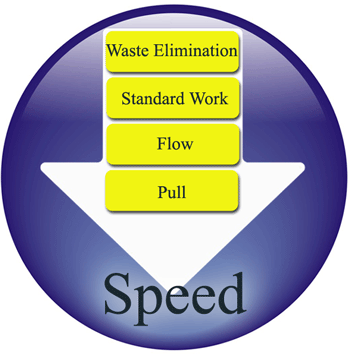 The aim is not to work faster and harder, but to worker smarter. To enable this to happen, one must focus on elimination of waste in every process; for processes to be standardised, so everyone works exactly the same way every time; making just what the customer wants, and only what he/she wants; and being able to produce only when the customer makes an order.
This must then be completed in a way that is efficient, which creates lean flow through the plant.
Employee Empowerment
The only way to drive a Lean philosophy across the whole organisation is to create a Lean Culture and that means engaging the workforce, and in particular, those running the processes!
This means Lean improvements are not “done to them,” but the workforce are actively involved in improvement workshops, which are commonly called a Lean-Kaizen, or Kaizen.
Through the constant pursuit of improvements by directed teams, whereby everyone is empowered, whilst learning by ‘doing’, companies can start to see big gains within their businesses, as each wasteful activity is removed or reduced.
Lean Origins
The origins of Lean emanate from The Toyota Production system (TPS) from the 1970’s, based on a vision from Mr Toyoda, to be market leader in the Automotive sector. The TPS system embraced good production practices, carried by TQM and Henry Ford, for example, but were developed furthermore to cope with today’s changing customer demands.
Concepts are constantly adopted and used and most Blue chip companies use Lean as a part of their Operating strategies to remain competitive and drive costs down.
Lean can be used not just within Manufacturing, but any business, and nowadays, many industries and sectors, including Finance, Health care and even Garden Nurseries employ lean Six Sigma to control their processes and drive waste out of their businesses.
The Five Lean Principles: A Practical Roadmap
Lean Manufacturing is built on five core principles, developed from the Toyota Production System and codified by Womack and Jones in Lean Thinking (1996). These principles provide a practical sequence for implementing Lean in any operation — manufacturing or service.
1. Specify Value — Define value from the customer’s perspective. What is the customer actually willing to pay for? Everything that does not contribute to this definition is, by definition, waste. This step requires direct engagement with customers, not internal assumptions about what they value.
2. Map the Value Stream — Identify every step in the process from raw material (or initial request) to delivered product or service. Value Stream Mapping makes all three types of activity visible: value-adding steps, necessary non-value-adding steps (which cannot yet be eliminated), and pure waste (which can and should be eliminated immediately).
3. Create Flow — Once waste steps are removed, make the remaining value-adding steps flow continuously without interruption, batching, or waiting. Flow is the antithesis of batch-and-queue processing. Achieving flow often requires cross-functional thinking and a willingness to reorganise equipment or work sequences.
4. Establish Pull — Produce only what the customer needs, when the customer needs it. Pull systems are triggered by downstream demand — customer orders pull production through the system. This eliminates overproduction, the most costly of the seven wastes, and dramatically reduces inventory holding costs.
5. Pursue Perfection — Lean is not a project with an end date; it is a continuous improvement philosophy. As each cycle of improvement removes waste and improves flow, new layers of inefficiency become visible. The pursuit of perfection is the engine that sustains Lean beyond the initial implementation phase and prevents regression to old methods.
Where to Start: The Lean Implementation Sequence
Organisations new to Lean frequently make the mistake of jumping directly to tools — implementing 5S, drawing Value Stream Maps — without first building the cultural foundations. The most effective sequence is: start with a pilot area that has visible, measurable problems; apply the five principles to that area; demonstrate results; and then use that success to build credibility and capability for broader deployment. Tools without culture produce temporary improvement. Culture without tools produces enthusiasm without results. Both are required.