
What Is the Johari Window?
Key Terms
- Johari Window
- A self-awareness and interpersonal communication model, developed by psychologists Joseph Luft and Harrington Ingham in 1955 (the name combines their first names), that maps what is known and unknown about a person into four quadrants: Open, Hidden, Blind, and Unknown. The model is widely used in leadership development, team-building, and coaching to improve self-disclosure, feedback, and mutual understanding.
The Four Quadrants Explained
| Quadrant | Known to Self? | Known to Others? | What It Contains |
|---|---|---|---|
| Open (Arena) | Yes | Yes | Information freely shared — skills, behaviours, attitudes known to both self and others |
| Hidden (Façade) | Yes | No | Information kept private — feelings, fears, motivations the individual knows but does not share |
| Blind Spot | No | Yes | Behaviours and traits others observe but the individual is unaware of |
| Unknown | No | No | Unconscious traits, latent potential, and unexplored capabilities unknown to both |
How to Use the Johari Window for Leadership Development
The practical goal of the Johari Window is to expand the Open quadrant by reducing the other three. Two processes achieve this:
- ►Disclosure — Voluntarily sharing information from the Hidden quadrant reduces its size and expands the Open area. This requires psychological safety — trust that disclosure will not be used against the person.
- ►Feedback — Receiving feedback from others moves information from the Blind quadrant into the Open area. The larger the Blind Spot, the greater the leadership risk.
Leaders with large Open quadrants and small Blind Spots tend to be more self-aware, more predictable to their teams, and better at building trust. 360° feedback programmes directly address the Blind Spot quadrant.
Related Self-Awareness and Team Resources
- ►Emotional Intelligence Theory: The Self-Awareness Foundation
- ►Providing Great Feedback: Reducing Blind Spots in Others
- ►Belbin Team Roles: Complementary Strengths in Teams
- ►Situational Leadership: Reading Your Team
🔗 Related: Maslow’s Hierarchy of Needs: Self-Awareness and Human Motivation
The following section contains our original guide to using the Johari Window.
The Johari window helps answer the age old question of how to build trust within a group and therefore build an effective team.
Ever seen or indeed been a part of a team that had synergy? That the team members were open and honest, working well with each other? As a result, the team probably achieved good levels of success and were very effective in meeting tasks and objectives. You probably too, got a feeling that things seemed a lot easier and there was a sense of organisation and joviality amongst the group.
You will probably agree that trust is critical for the success of any team. I’m sure you have seen instances in teams when trust hasn’t been there: failure normally follows. Trust, then seems an integral part of forming an effective team.
The question is how do you build trust?
Time to Reflect and Communicate
One way to do this is to use the Johari window. The tool, developed by Joseph Luft and Harry Ingham in 1955, was created to allow people to communicate and ultimately ‘open up’ and improve awareness of each other, in which an understanding of important things about yourself and other members of the team can result.
The theory is simple: The more others understand you and the more you open up to each other, the more rapport, and trust is developed and as a result, relationships can strengthen.
The Johari Window is built on two key principles:
- ►That you build trust with people when you disclose information about yourself
- ►Using feedback, you can learn a great deal more about yourself, therefore coming to terms with issues and increasing your self awareness and effectiveness as an individual.
By explaining the idea of the Johari Window, you can help team members to understand the value of self-disclosure, and encourage them to both give, and accept, constructive feedback.
Done sensitively, this can help people build better, more trusting relationships with one another, solve issues, and work more effectively as a team.
Johari Window Explained
The model is based on a four grid format, whereby each quadrant represents a current state of play.
The Four Quadrants:
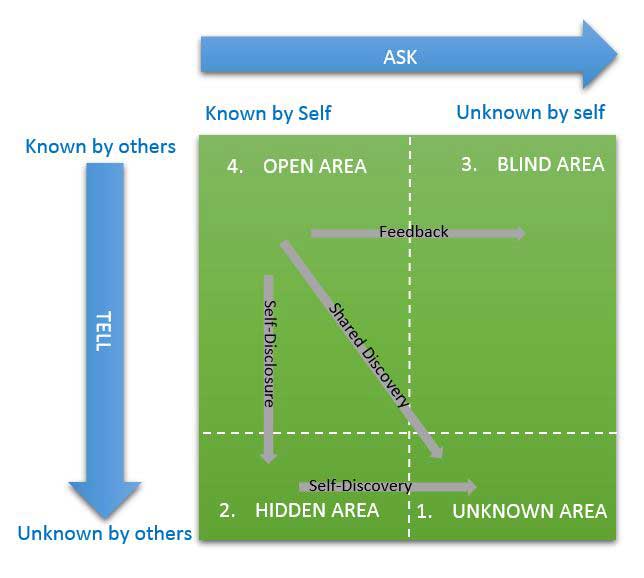
- ► Unknown Area: what is unknown by the person about him/herself and is also unknown by others
- ►Hidden Area: what the person knows about him/herself that others do not know
- ► Blind Area: what is unknown by the person about him/herself but which others know. This can normally include things like anxiety, fear, incompetence, unworthiness and so on, whereby it is difficult for people to face up to, but others can easily see them clearly in you.
- ►The Open area: what is known by the person about him/herself and is also known by others. This normally includes your behaviour, knowledge, skills, attitudes, and ‘general knowledge’ history.
The Goal of The Johari Window:
So, we have digressed what the Johari window is and the theory behind it, but what is the actual use of the model? How do we apply it? The ultimate goal is to enlarge the open area, so people can learn about you and you about yourself. By doing this, trust and deep relationships can be built, as the more you know about each other, the more productive, cooperative and indeed effective people will be when working together.
This process of opening up and increasing the open area of your window, is called self-disclosure and is more of a learning process, following down a two-way communication journey.
Notice I said at the start, that there are two key principles of the Johari Window:
- ►You build trust and insight by telling people about you
- ►Secondly, you build more trust and insight through soliciting feedback from others.
By following these two principles, and sharing information, you effectively increase your open area on the diagram, as the more you discuss yourself, the more the hidden area retreats. Also too, the more you gain feedback, the more your open area also expands and your blind area gets smaller.
Done well, the process of give and take, sharing, and open communication builds trust within the group.
How to Use the Johari Window
- ►Explain the Johari window to your team, or print this article out and run through it with them.
- ►Get the team to start to think how they open up everyone’s open area.
- ►Start small, and get the team to share small, harmless items to help build disclosure and trust. The more the team open up (sensibly) and disclose thoughts, feelings, goals and ambitions, the more trust is built.
- ►Regular sessions are good for this, so set time out to help the team get together and talk.
- ►Ensure that people open up only to what they want to. Uncovering deepest darkest secrets may not be advisable, especially to start with! Secondly, Ensure people open up in a positive way and not disclose information that could damage respect for others.
- ►Don’t forget to encourage people to provide feedback as this not only opens up the Blind Area in the model, but is a great tool for personal growth.
- ►You can cause incredible offense if you offer personal feedback to someone who’s not used to it, so be sensitive, and start gradually.
- ►Focus on feedback, shared discovery together, self disclosure and self discovery to help the team develop understanding and grow together.
- ►Constructive feedback is a great method to use, so it is worth spending time to develop your constructive communication skills.