
What Are Influence Tactics?
Key Terms
- Influence Tactics
- Methods used by leaders, managers, and communicators to change the attitudes, beliefs, or behaviours of others without direct authority or coercion. Effective influence is not manipulation — it is the legitimate use of evidence, relationships, framing, and psychological principles to help others arrive at a decision that serves both parties’ genuine interests.
Robert Cialdini’s research, published in Influence: The Psychology of Persuasion (1984) and based on three years of undercover study of compliance professionals, identified six universal principles that reliably increase the likelihood of a “yes.” These principles work because they align with deeply rooted psychological heuristics that humans use to navigate a complex world efficiently. Understanding them makes leaders more effective communicators, negotiators, and change agents — and more resilient to being manipulated by others who use them unethically.
Cialdini’s Six Principles of Influence: Applied to Leadership
| Principle | Core Mechanism | Leadership Application |
|---|---|---|
| Reciprocity | People feel obligated to return favours | Give genuine help, information, and support before asking for commitment or behaviour change |
| Commitment & Consistency | People align future behaviour with past public commitments | Ask for small public commitments early in a change; people then act consistently with them |
| Social Proof | People look to others’ behaviour to guide their own | Share examples of peers who have adopted new behaviours; use pilot group successes as evidence |
| Authority | People defer to credible experts | Demonstrate expertise through data, credentials, and track record; cite credible external sources |
| Liking | People comply more readily with those they like | Build genuine relationships; find authentic common ground; show interest in others’ perspectives |
| Scarcity | People value what is rare or diminishing | Frame opportunities with genuine time or resource constraints; highlight unique access or windows |
Ethical Boundaries: Influence vs. Manipulation
The distinction between ethical influence and manipulation is not the technique used — it is the intent and accuracy with which it is applied. Ethical influence:
- ►Uses accurate information (not fabricated social proof or false scarcity)
- ►Serves the genuine interests of both parties
- ►Would survive being disclosed: the person would not feel deceived if they knew the tactic being used
Leaders who use influence tactics manipulatively damage trust rapidly and permanently. Cialdini himself emphasised that his principles are most powerful when used to surface genuine value, not to manufacture false perceptions of it.
Related Influence and Leadership Resources
- ►Emotional Intelligence: The Foundation of Personal Influence
- ►Motivation Theories: Understanding What Drives Others
- ►Communication Process Model: Removing Noise from Your Message
- ►Transformational Leadership: Inspiring Through Vision
🔗 Related: Winning People Over: Building Influence Through Genuine Relationships
The following section contains our original guide to Cialdini’s influence tactics.
In order to master the use of influence tactics, one must learn the science of persuasion.Let’s imagine for a second that you have a great new process created for your team, whereby it involves the ability for your team to adopt new approaches and a new way of working. You know that it will force many out of their comfort zone, but still, if you can get buy-in, the financial savings in efficiency are ten-fold.
Alternatively, you may have an exciting new product that you want to release to the market, which could potentially solve an age old problem for many consumers around the globe. Firstly, you just need to convince some stakeholders to buy in to the product in order to get it on the shelves to sell.
In both instances, how would you go about influencing someone to agree with your views and follow your lead?
The Challenge
Being able to successfully influence someone is a challenge in itself, but there are proven influencing tactics that we can all use, which tap into our natural behaviours as individuals and therefore help persuade others into ‘complying’ with what we want them to do.
Influencing people can come from many needs. Typical (but not exhaustive) reasons are:
- ►Process Improvements and changes in working practices
- ►Organisational cultural change
- ►Enticing more customers to buy from you
- ►Encouraging team members to learn new skills
Whatever it is, a requisite of successful leadership is to be able to communicate effectively and influence stakeholders to enact the desired outcomes.
So, how do you influence a decision?
Cialdini’s Six Principles of Influence
One of the most popular and favoured set of influence tactics comes from a man called Robert Cialdini.
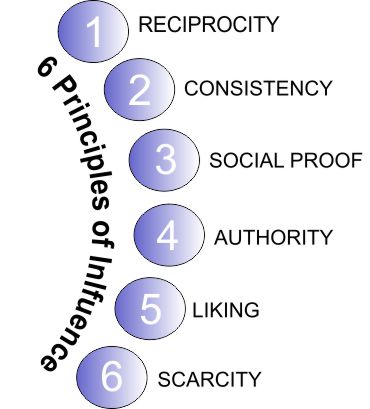 Cialdini published the six principles of influence in his 1984 book “Influence: The Psychology of Persuasion,” and during his studies, prior to his book release, he spent years watching successful salesmen and marketers at work, asking the question, “what makes people buy from them?”
Tapping into Our Subconscious
The argument is that we are all from the animal kingdom. Just as we share this trait, we all share the ability to work in auto pilot, if you like – to run on scripts, which are automated and plugged into our basic instincts.
Much like a bird sings, a cow milks, dogs bark, we react to certain influences, which is part of our DNA.
If you think about it; we are exposed to so many stimuli around us, probably more than ever before in the history of the human race. As a result, we just cannot take in all the stimulus and signals consciously.
If we did, we would simply be overloaded and our brains wouldn’t be able to cope.
Cue the automated, subconscious routines.
Our brain consciously chooses the stimulus to focus on and discards the stuff it feels we don’t need to waste time thinking about. So too, many actions are performed without much thinking and in some cases, our natural instincts help us conduct daily lives, whereby we react to stimulus without even knowing, consciously.
Cialdini, as a result, identified six influence tactics that tap into our natural instincts as humans and can be used to help persuade us to adopt certain behaviours. These six key principles of influence, Cialdini argues, are the science behind how we are wired, and whether we like it or not, we respond positively to them. As a result, we can be influenced by people and organisations that use them.
The six key Influence Tactics are:
- ►Consistency or commitment – The first of the influence tactics demonstrates that We normally follow consistency, so if someone commits on a small level to something, they are more likely to be consistent and continue committing to it later. An example in the sales world is to ‘try before you buy’. The chances of purchasing after this are greater than purchasing ‘cold’.
- ►Reciprocation – As humans, we generally aim to return favours and pay back people that have given us something. By offering something to someone can help them feel obliged to return the favour and compelled to ‘comply’. Again, in the sales world, this could be a free gift added in.
- ►Social Proof – We are influenced by other ‘similar’ people. If a team works late, then maybe we will too in order to comply. Again, if a group of people are doing something, then there is a greater chance that others will inherently follow through this peer following. The social proof influence tactic gently persuades our sub conscious that if other people are doing something, so should we.
- ►Authority – We feel a sense of obligation and duty to people who are seen as being authoritative in their positions. A great example would be that of advertisers of pharmaceutical products: often a doctor is seen promoting their products to help drive a level of authority. We don’t normally argue against experts in their fields!
- ►Liking – We are more likely to be influenced by people we like. Likeability comes in different ways: People may be familiar to us or share similar views and opinions. Likability may also come in the form of trust, but either way, we are influenced by those we are affiliated to.
- ►Scarcity – This influence tactic is seen a lot in advertising. Often, we hear, “for a limited time only,” or, “only xx left!” It is with the principle that people need to know what they are potentially missing out on if they fail to act. By providing the scarcity rule, the chances of more people responding are increased.
For a more detailed overview, please see the video below of “Influence Tactics”: The science of persuasion. Please feel free to take notes and learn the key principles that can enhance your influencing and leadership skills.
How to use These Influence Tactics
You can use these principles and influence tactics whenever you want to persuade other people to comply with a certain behaviour. Just remember, successful leaders do not manipulate and deceitfully gain advantage. They are open and people-driven leaders, so use the tool fairly and morally.
- ►Start with the end in mind – know your objectives and what you are trying to get out of the situation. What does success look like?
- ►Understand your team members that you are trying to influence and select the correct influence tactics that would suit the situation.
- ►Use the strategies to suit. Here are a few examples of how to use each influence tactic:
Consistency / commitment – Try to get their commitment early into the project or conversation. Try too, to get them to commit to something small. There is more chance of them progressing and developing their commitment once they have already contributed something to it. Also, try to get someone to commit to something preferably in writing, perhaps in the form of a SMART objective , or a signing of a project charter, or an agreement to be a part of an improvement project. This provides more of an anchor towards future commitment.
If you are selling a product, provide a small trial period, or taster session to entice the customer to make an initial commitment, or offer a 100% money back guarantee.
Reciprocity – Think about your objectives again and identify how you can give something to the person/s involved. It may even be just a gentle reminder of how you have helped in the past. Try to demonstrate ways to show a little give and that the person/s are benefiting from it. By providing the sense that you have ‘scratched their backs’, they are more inclined to oblige to do something in return.
Liking – Be natural and fair; be open and honest in your actions and have a general interest in people and their welfare. This forms the basis of good leadership and will also begin to build trust, which is one of the branches of liking and respect.
Secondly, provide genuine praise and positive feedback to your team members. Start by observing yourself, and note how many times you give positive to negative feedback in a day. Like most of us, you may be surprised! Aim to give a positive to negative feedback ratio of 3:1.
Develop too, your emotional intelligence and listening skills and don’t go out of your way to be liked. Being yourself and a good leader will ensure that you are genuine and your followers will genuinely believe in you.
Authority – Find ways to show others of your expertise, so everyone can understand your strengths and knowledge.
Scarcity – If you are selling a product, ensure you give the customer a limited time available, in order to buy, or limit the stock, and so on and so forth. The trick here is to demonstrate a clear limitation and also what would happen if you do not ‘comply’ or act.
In terms of influencing people within a team setting, the creation of urgency is key. Again, demonstrate the need to change and what would happen if this is not achieved within a certain period of time. This principle falls nicely into the one of Kotter’s change model steps.
Social Proof – Referring to our change article and the 2:6:2 model, ask the question, “who are those innovators and early adopters that you need to bring on board? And how can you best communicate to everyone that you have critical buy-in and peer followers? Focus on finding the right people and then communicating this message to show support in the programme.
Remember, if you master the art of communication and indeed successful influence tactics, your whole world as a leader can be enhanced.
It can be an extremely effective and rewarding experience to influence those around you to act.
To be able to tap in to the psyche of the human mind using a range of influence tactics and to persuade people in a positive, fair and moral way, will have a profound impact on your role as a leader.