
What Is Herzberg’s Motivation Theory?
Key Terms
- Herzberg’s Two-Factor Theory
- A motivation theory developed by psychologist Frederick Herzberg (1959), based on interviews with 203 accountants and engineers, which found that the factors causing job satisfaction are fundamentally different from the factors causing job dissatisfaction — not opposites on the same scale. Herzberg called these two independent dimensions Motivators (intrinsic factors that create satisfaction and engagement) and Hygiene Factors (extrinsic factors whose absence creates dissatisfaction but whose presence does not motivate).
Herzberg’s insight challenged the prevailing management assumption that higher pay and better conditions automatically produced greater motivation. His research showed that the absence of hygiene factors causes dissatisfaction, but their presence merely prevents it — it does not create positive motivation. That requires an entirely different category of intervention.
What Are the Two Factors?
| Hygiene Factors | Motivators |
|---|---|
| Company policy and administration | Achievement |
| Supervision and management quality | Recognition |
| Salary and compensation | The work itself (interesting, meaningful) |
| Interpersonal relationships | Responsibility |
| Working conditions (physical environment) | Advancement and promotion |
| Job security | Growth and learning |
Practical implication: Increasing salary, improving the office, or resolving management problems will reduce active dissatisfaction — but will not produce engaged, motivated performance. To produce genuine motivation, managers must invest in the right column: meaningful work, recognition, growth, and responsibility.
What Are the Criticisms of Herzberg’s Theory?
- ►Sample bias — Original research used only white-collar professionals; generalisability to other contexts has been questioned
- ►Attribution bias — People tend to attribute satisfaction to their own actions (achievement) and dissatisfaction to external factors (management) — potentially skewing Herzberg’s categories
- ►Individual differences ignored — Some individuals are genuinely motivated primarily by financial reward, which the theory undervalues
- ►Context ignored — Cultural, national, and generational differences affect which factors motivate most
How to Apply Herzberg’s Theory as a Manager
- ►Audit hygiene factors first — If basic conditions are poor (unfair management, poor working environment, inadequate pay), fix these before investing in motivator programmes. Motivators are invisible against the noise of hygiene dissatisfaction.
- ►Build motivators into job design — Use job enrichment: increase autonomy, skill variety, task significance, and feedback. These are the levers that produce genuine engagement.
- ►Give specific recognition — Vague praise has limited motivational impact. Specific, timely recognition of achievement is one of the highest-leverage, lowest-cost motivators available.
- ►Create growth paths — Visible development opportunities retain talent and sustain motivation more effectively than compensation increases alone.
Related Motivation Resources
- ►Motivation Theories: A Complete Manager’s Guide
- ►Maslow’s Hierarchy of Needs: Application for Managers
- ►Providing Great Feedback: Activating the Recognition Motivator
- ►Setting SMART Goals: Creating Achievement Opportunities
🔗 Related: How to Improve Employee Engagement: Practical Steps from Herzberg
The following section contains our original guide to using Herzberg’s Motivation Theory.
Herzberg motivation theory attempts to answer the age old question of what do people get motivated by? What do they want in their jobs and how to improve the conditions for people to flourish?
Do employees want good working relationships, a better salary, better job prospects, status, or something else altogether?
Frederick Herzberg
Frederick Herzberg set out to answer this question in the 1950s and ‘60s to help managers better understand how to motivate their workers. In much the same way as Maslow and Vroom, he conducted a number of experiments to determine the effect of motivation. He did this by asking people to describe instances when people were unhappy in their jobs and also when they were happy.
Herzberg found an interesting set of results: He identified that those people that felt good about their jobs gave totally different responses to those that were unhappy. These results formed a significant paradigm shift in understanding, which allowed him to adopt a model called Herzberg motivation theory; also referred to as Hertzberg Hygiene Theory or Two Factor Theory.
The Herzberg motivation theory is a simple, yet powerful tool which still forms the bedrock of motivational practices today and is used to help organisations create the optimum environment to motivation in its individuals.
Hertzberg Motivation Theory
From his research, Herzberg found that there are certain characteristics of a job that consistently relate to job dissatisfaction, and there are other factors which, in the same breadth, relate to job satisfaction. These factors can be seen in the diagram below:
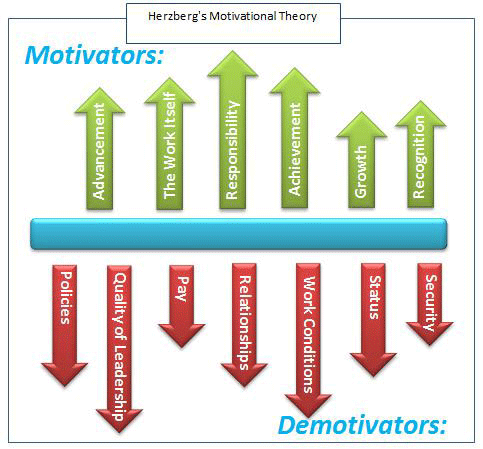
The main conclusion of Herzberg motivation theory is that there is no real correlation between job satisfaction and job dissatisfaction. What I mean by this is that:
- ►The opposite of Dissatisfaction is No Dissatisfaction
- ►The opposite of Satisfaction is No Satisfaction
In a Nutshell…
By using Herzberg’s hygiene theory, simply eliminating the causes of dissatisfaction in a job WILL NOT CREATE SATISFACTION! It will merely create a situation whereby the person is neither satisfied nor dissatisfied. In other words, they will be in a ‘neutral state’, but will not be motivated.
This, is a drastic shift in thinking, as in many instances in management, most people can probably admit that the thought of eliminating something that causes dissatisfaction in the work place is all that needs to be done. In reality, though, it only stops the dissatisfaction and does not add to satisfaction and motivation!
The same is true for satisfaction: by improving the factors around job satisfaction, without eliminating the dissatisfaction factors, you will not achieve a motivated individual.
An Example
If an individual is working within a company with outdated and sub-standard policies, whilst also operating in a negative and hostile environment, contrary to many people’s beliefs; simply giving them a pay rise will not suddenly motivate them.
Equally too, if someone is working under a poor supervisor and has relationship issues with that person, by simply giving them extra money to stay may not add to this person being motivated, as the demotivating factors are still there.
There are many examples one could use to highlight the workings and logic to Herzberg motivation theory, but the general concept is that in order to motivate an individual, you have to do two things:
- ►Remove the demotivating factors – Herzberg termed these as Hygiene factors. By doing this, you begin to make people neutral. In other words, you are removing the dissatisfying factors and bringing people over to the not-dissatisfied state.
- ►Improve / augment the satisfying factors – Once the team are in a neutral state, you must then look to add the areas of satisfaction to improve motivation and happiness. Such things around achievement, recognition, work role, responsibility, advancement, and growth all have a part to play in effectively beginning to satisfy individuals.
Tips using the Herzberg Motivation Theory
- ►Do not assume that by removing the Hygiene (demotivating) factors, people will be happy – This is a common mistake made by many-a-manger. From my experience, there is a wide misconception that money is a large motivator. The perception of a lack of money is only a demotivating factor, so simply paying the appropriate rate will only make people not dissatisfied.
- ►The Model is good, but talk to your team members – Different people have different satisfying and dissatisfying factors, so it is worth talking to them to really understand the factors they highlight as frustrating and satisfying.
- ►Remove the Hygiene Factors first – Remember, focus on the removal of those factors that are causing dissatisfaction, to bring people into a ‘neutral state’ and then, after this has been completed, get to work with improving the satisfying factors to enhance their satisfaction levels.
- ►The Herzberg motivation theory focuses predominantly on job enrichment – Think of ways you can empower, delegate, enhance job roles to keep people interested and stimulated. A good tool to help in this is the Situational Leadership Model or our Flexible leader E-Course.
How to use Herzberg’s Hygiene Theory
To successfully apply Herzberg’s theory, you need to adopt a two –phased approach:
- ►Eliminate the hygiene factors
- ►Create conditions for job satisfaction
Step 1. Eliminate Job Dissatisfaction:
- ►Identify obstructive and non-effective policies and systems and set out to remedy them
- ►Provide effective leadership; one that supports the role, and which is non-intrusive
- ►Create an environment that is supportive of good working relationships. Build teamwork and respect for each other
- ►Ensure the pay is competitive with market conditions
- ►Provide a foundation for job security and stability
- ►Create job status by aiming to provide meaningful work for every position
Step 2. Create the Conditions for Job Satisfaction:
Examine every job to see if it can be made better and more satisfying for the worker. Typical things to look at when doing this are:
- ►Create opportunities for achievement in the role
- ►Provide recognition and feedback for worker’s contributions to the role
- ►Create and evolve the role to enable it to be rewarding, stimulating and matches the abilities of the person
- ►Provide a foundation of delegation and responsibility for each team member, as much as possible. Again a good tool to use is the Situational Leadership Model
- ►Help provide a roadmap to promotion, whereby individuals can advance through the business via internal promotions and a clear success path
- ►Provide training opportunities to help individuals grow in their roles and support advancement to positions that they aspire toward.