
What Is the DMAIC Methodology?
Key Terms
- DMAIC Methodology
- A structured, data-driven problem-solving framework used in Six Sigma and Lean Six Sigma initiatives. The acronym stands for Define, Measure, Analyse, Improve, Control. DMAIC provides a disciplined, repeatable sequence for identifying and permanently eliminating the root causes of defects and process variation.
| Phase | Purpose | Key Tools | Output |
|---|---|---|---|
| Define | Define the problem, scope, and customer requirements | Project Charter, SIPOC, Voice of Customer | Problem statement; measurable goal |
| Measure | Quantify current process performance with data | Process maps, Measurement System Analysis, baseline Sigma level | Current state baseline |
| Analyse | Identify root causes of defects and variation | Fishbone, 5 Whys, hypothesis testing, Pareto analysis | Verified root cause(s) |
| Improve | Develop, test, and implement countermeasures | DOE, Kaizen events, piloting, solution selection matrix | Implemented improvement |
| Control | Sustain the improvement and prevent regression | Control charts, updated SOPs, training, control plans | Sustained new process standard |
DMAIC in Practice: Common Pitfalls and How to Avoid Them
Understanding the DMAIC methodology in theory and applying it effectively in practice are two different skills. The most common failure mode is not choosing the wrong tool — it is rushing through the early phases to get to Improve, the phase where visible action happens. This impatience consistently produces superficial solutions that address symptoms rather than root causes, causing the same problem to recur within months of project closure.
The Define phase is where most projects fail before they start. A vague problem statement — “productivity is low” or “quality needs to improve” — makes every subsequent phase unfocused. The Define phase must produce a specific, measurable problem statement with a clear baseline and a quantified improvement goal. Without this, the Analyse phase has no anchor, and countermeasures in the Improve phase are selected on intuition rather than evidence.
The Measure phase is where many teams discover that they do not actually have the data they assumed they had. Measurement System Analysis (MSA) often reveals that the measurement process itself introduces significant variation — making it impossible to distinguish real process signals from measurement noise. Skipping MSA and using unreliable data through the rest of the project is one of the most common and costly errors in Six Sigma practice.
The Analyse phase requires genuine hypothesis generation and statistical validation — not just brainstorming on a Fishbone diagram and picking the most popular answer. Confirmed root causes must be verified with data. A hypothesis that “machine changeover time is causing defects” must be tested against actual data before resources are committed to fixing it.
When DMAIC Is the Right Tool — and When It Is Not
DMAIC is designed for improving an existing process that is underperforming in a known, measurable way. It is the correct tool when:
- ►The problem is recurring and the root cause is unknown
- ►Data exists (or can be collected) to characterise process performance
- ►The solution is not already known — if it is, DMAIC adds bureaucracy without benefit
- ►The improvement needs to be sustained long-term, not just patched
DMAIC is not the right tool when designing a new process from scratch (use DMADV/DFSS instead), when the problem is an isolated incident rather than a systemic pattern, or when the organisation simply needs to execute a known best practice rather than investigate an unknown root cause.
Used correctly, DMAIC is one of the most powerful tools available for permanent elimination of process variation. The key is discipline: complete each phase fully before moving to the next, and resist the pull toward action before the analysis is complete.
Explore the Full Lean and Continuous Improvement Toolkit
- ►Lean Manufacturing: Definition and 5 Principles
- ►Plan Do Check Act: The Improvement Cycle
- ►The 7 Wastes: Identifying and Eliminating Muda
- ►TQM Tools: Quality Management Toolkit
🔗 Related: Lean Six Sigma: Combining Lean and DMAIC for Maximum Impact
The following section contains our original guide.
DMAIC methodology is another problem-solving framework that’s designed to hunt out and eliminate problems.
Very similar to its cousin, the PDCA cycle, it has its origins from TQM movement.
It’s used extensively when applying Six Sigma to process improvement, but the DMAIC methodology is used by many also as a way of following improvements in a structured way.
Sometimes without even using Six Sigma at all.
In my experience, it’s just as good as the PDCA approach. Some would say better.
It allows you and your teams to be competent problem solvers.
And to avoid the typical work around, short term solutions that most organisations follow.
The 5 Step DMAIC Methodology
The DMAIC methodology is structured around the DMAIC acronym.
It stands for:
Define: Define the problem or project. Get to grips with exactly what the current state is and what the intended improvement outcomes should be.
Measure: Measure the process so you can see what the impact of the problem is. Define what you’re going to measure, so you can understand the problem in greater detail.
Analyse: Analyse the process to understand the root cause(s) and the reasons for defects.
Improve: Improve the process by eliminating the root causes.
Control: Control the process by standardising the new way of working. Ensuring the problem doesn’t come back.
DMAIC Methodology Cuts Through the Noise
When starting the journey of improving, you’re faced with many X’s. These X’s are a multitude of factors that could be causing the process to behave incorrectly – be it delivery problems, defects and any other variation to plan.
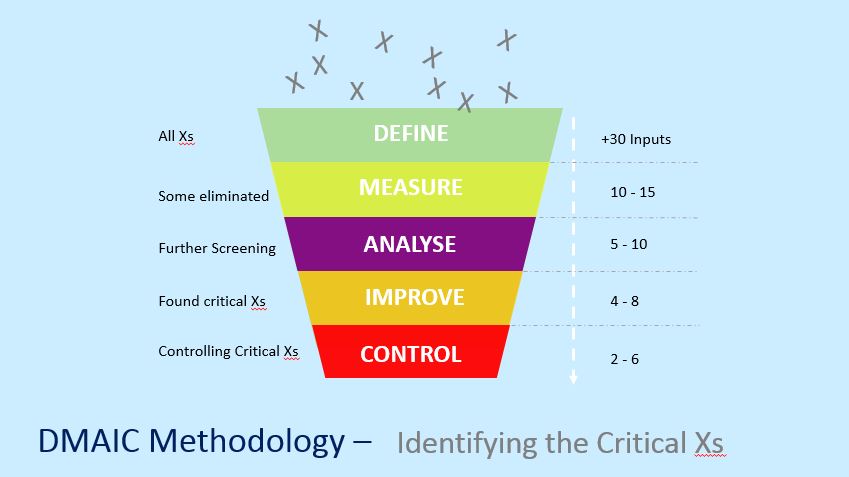
DMAIC Methodology – Critical Xs
When you walk through the DMAIC roadmap, you’re effectively gaining more knowledge about the process, using data and analysis.
And as you do, you start to dismiss possible root causes (or X’s), and filter more out, using data and theories.
This process is repeated, until you get to the real root cause of the problem and have proven it through data and experimentation.
Feedback Loops
Although the DMAIC methodology is linear in its approach, it’s there to merely provide structured problem solving. This ensures the project leader tackles the problem in a standard and detailed process every time.
Consistency and structure is the name of the game in the DMAIC methodology.
It’s the only real way to ensure you eliminate problems, as opposed to artificially working around them…. And merely patching things up.
That’s why the analysis and experimentation may mean you go back and forth through the DMAIC methodology, to ensure the right root cause is found and eliminated.
For instance, you may be at the analyse phase, but you have to return to the measure phase to understand something new.
You might even be at the improve phase… But may have to return to do more analysis and experiments to ensure that what you’ve identified is the actual root cause.
The DMAIC Methodology and Typical Tools
Here’s the DMAIC Methodology in more detail, when used to conduct process improvements.
Notice the heavy reference to statistical tools. A lot of people get hung up on trying to implement all the 6 sigma tools.
But the bottom line is to eliminate a root cause(s) to a problem.
If you can follow DMAIC and eliminate the problem, using 10% of the tools, then job done!