
What Is the Change Management Process?
Key Terms
- Change Management Process
- A structured sequence of activities that guides an organisation through planned transformation — from identifying the need for change, through planning and communicating the transition, to embedding new behaviours and measuring sustained adoption. Effective change management addresses both the technical dimension (what changes) and the people dimension (how people experience and adopt the change).
McKinsey’s research across 40 years of transformation programmes found that 70% of change initiatives fail to achieve their objectives. The primary causes are almost always people and culture factors — inadequate leadership commitment, insufficient communication, failure to manage resistance, and absence of reinforcement — rather than technical or strategic failures. The change management process exists to systematically address these human factors.
Why Is the People Dimension So Critical?
Organisations do not change — people in organisations change. Or they do not. And whether they do depends almost entirely on:
- ►Understanding — Do they know why the change is happening and what the vision looks like?
- ►Belief — Do they believe the change is necessary and achievable?
- ►Capability — Do they have the skills, tools, and resources to work in the new way?
- ►Reinforcement — Are new behaviours recognised, rewarded, and embedded in systems and processes?
The Change Curve describes the emotional journey individuals travel when confronted with significant change. Effective change managers understand where each person is on that curve and intervene accordingly.
Common Reasons Change Management Processes Fail
- ►Underestimating resistance — Resistance is not obstruction; it is information. It signals unaddressed fears, capability gaps, or legitimate concerns about the change design.
- ►Communication that informs but does not engage — Announcing change through cascades and emails creates awareness but not commitment. Two-way dialogue creates buy-in.
- ►Leadership behaviour inconsistency — When senior leaders communicate the new way of working but continue behaving in the old way, the signal is clear: the change is not real.
- ►Declaring victory too early — New behaviours require approximately 66 days of consistent practice to become habitual (Phillippa Lally, UCL, 2010). Removing reinforcement structures prematurely causes regression.
Related Change Management Resources
- ►The Change Curve: Understanding Emotional Reactions
- ►Change Management Models: Lewin, Kotter, ADKAR Compared
- ►Communication Process Model: Keeping Teams Informed
- ►Emotional Intelligence: Leading the Human Side of Change
The following section contains our original step-by-step change management process guide.
In a world that is increasingly fast paced and ever changing, the change management process is an integral part of any organisation and manager.Whether planning a large fundamental change or a smaller incremental one, change must be planned and executed correctly and the following change management process will give direction in terms of content needed for successful transformation.
Change is about People
As my old mentor used to say – “It’s about 90% people and 10% tools!”
People are dynamic. They are the hardest things to change – after all, we all have our own systems, beliefs and values. We all change at different speeds and we will only change if we believe in the vision. Changing people means that we have to use our Leadership skills to enable the vision to be successful and that change to be embedded: this means nurturing people through the change curve effectively.
Casualties along the way
For a number of reasons, not everyone will eventually change anyway, but the focus must go on at the planning phase to understand those affected and to also gauge how change ready people are. A simple and unscientific rule, but still a good measure to use, is the 20:60:20 model.
– Try and find the 20% of those affected that seem to be ready for change. These people will help lead and drive the changes necessary.
– Next, focus on finding the 60% – those that will sit on the fence and will follow either the concrete heads (those that don’t want to change) but equally, given the right exposure, will follow the 20% who are the converted.
– You are then left with a model of attack, whereby you have highlighted roughly 80% of the potential business that you believe will change, given the right environment. – Now you can make real progress!
The Change Management Process
The change management process focuses on four stages:
– Prepare
– Design
– Execute
– Sustain
This model will allow the practitioner to understand what generic steps to take along the change management process. The primary remit is to plan, plan, plan!
Plan for the transition and plan for change!
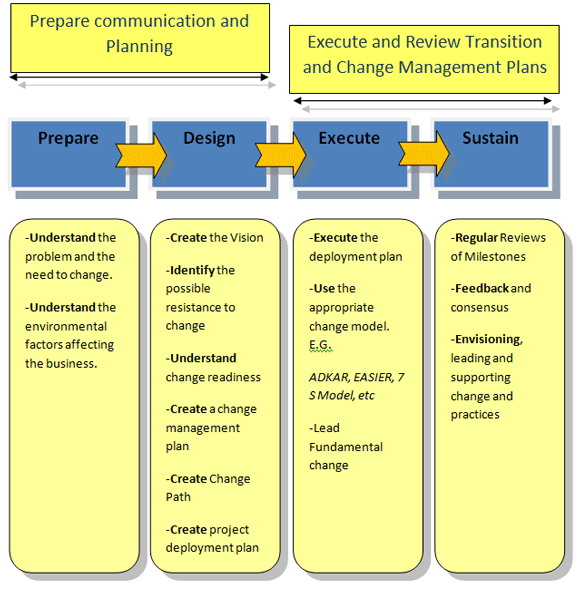
Prepare Phase
This part of the change management process involves identifying issues, environmental factors which are causing the need to change and any other accompanying data. There should be a lot of searching and identifying exactly what the real root cause to the problems being faced.
It must be clearly understood what is going on, and more importantly what is going wrong. Only then, once you have found these factors, you can work forward to create a vision with which will hopefully solve the current crisis.
The outputs from this phase are:
- ►A Baseline of current state.
- ►Root Causes to the current problems.
- ►A Vision of what the ideal state should look like.
Design Phase
The Design phase of the change management process is about adding the meat to the bones. It involves designing the way forward – planning the right path, using the correct change model and creating a robust process that leaves no stone unturned.
The design phase looks at the vision and works backwards to understand the steps needed to make the change process happen. It also focuses on the softer side – how will the transition happen? How will the cultural change happen, over how long and what needs to be put in place to allow people to change naturally?
By understanding as much information as possible, it is easier to manage the transformation through the course of the change management process. Moreover, you can address the issues in a clear and concise way.
Factors to understand and address at this phase:
Understand Change Readiness – Here, you can start applying the 20:60:20 model to identify the 80% that you can plan fundamental change with.
The Psychological Contract – Understand the change in the eyes of those affected – what will they feel they will lose? What impact will it have? What negatives will they see? Someone once wrote: A manager will spend 95% of the time explaining the impact of change to the organisation and only 5% about the impact effecting the individual. That person will go home and spend 95% of the time discussing the impact on them and only 5% of the time about the impact on the organisation! – Seeing in the eyes of the individual will give a greater return.
Create a plan to overcome resistance – Using such tools as Lewin’s Force Field Analysis, you can start to address possible barriers to successful change and then create a deployment plan to address those negative issues, closing out all the tasks when completed during the project.
Create the correct change path – understanding all of the above, now is the time to create the best change path. The change path is sometimes referred to as a Transition plan. It deals with real change, meaning the cultural transition. Typical models to deal with this are as follows, and will be your main driving tool through out the whole transformation covering Design, Execute and Sustain phases:
– 7S Model
The outputs from this phase are:
- ►Establish a clear project plan.
- ►Understand cultural barriers and create a transition plan to allow progressive cultural change to happen. Also, a clear understanding established of the correct change path model to use.
- ►Create a Change management plan to allow the process tasks of the project to be monitored and actioned.
- ►A Deployment Plan created, linking all the above in one change project plan.
Execute Phase
The preparation has been completed? it is now time to execute the plan using an agreed change path from the Design phase. Once this is in place, the next task is to communicate, communicate and communicate!
You can never over communicate and it is essential that regular feedback and coaching is conducted, tackling issues and the barriers that may have been preconceived at the design phase.
Here, Management must lead fundamental change, setting the bar, envisioning and encouraging.
The deployment plan comes into its own here: Tasks referring to the process of change must be implemented and also the change model must be thoroughly used and reviewed regularly to ensure effective execution.
The outputs from this phase are:
- ►Reinforcement mechanisms – To allow regular feedback and also regular communication about the plan and vision. The more channels of communication the better.
- ►Corrective action plans – Answering some questions like: What is working well and what needs addressing? What barriers are there? How is the transition plan working?
- ►Use and close out of the deployment plan.
Sustain Phase
Remember, Humans are creatures of habit – If new ways and systems are not encouraged and constantly driven, then it is natural for people to resort to the old way of working.
Sustaining, then, is all about maintaining the vision, supporting and leading the correct practices and behaviours. That means giving encouragement, but also really driving change through the business, using the workforce as real change agents.
The most important thing here is to stick with your change path model ensuring that you are spending enough time and giving enough attention to each of the softer, cultural requirements during the Transition. Omitting this will result in failure with the whole project.
The important thing to note is that although the change management process is linear in its approach, dealing with culture is not as simple as that. At times, there may be a need to return to the previous phases to address some issues, adjust the plan etc. This is fine, but ensure that change is being embedded through successful Leadership and positive focus in the change path model that you choose.
The outputs from this phase are:
- ►Compliance audit reports
- ►Corrective action plans
- ►Deployment plan reviews
- ►Celebrate successes
- ►Individual and group recognition approaches
- ►After action reviews
Those that Don’t Want to Change?
There should be a time when the 20% that do not want to change are given a choice – Go or stay. Change should never be enforced on people as there is no ownership in these instances in the longer term, which means that the business will be damaged, however there are times when coercion may be needed in times of urgency and only then! We can engage with the change or we can leave. As organisational development (OD) professionals, we need to recognise this as a legitimate strategy. We cannot and should not force change on people, our role should be to enable change and to encourage people to make a choice or decision during the change management process.
Feedback, and Communication
Remember to keep reinforcing the vision, whilst working through the deployment plan in your change management process – Regular reviews will ensure progress over a longer term. Asking questions along the way, like “What lessons did we learn, how could it be done better?” are always good questions to ask. No one ever gets things perfect, so understanding the weak points in the change management process and why change often fails will enable a more improved change process next time.