
What Is Emotional Intelligence (EI)?
Key Terms
- Emotional Intelligence (EI / EQ)
- The ability to accurately perceive, understand, manage, and effectively use emotions — both one’s own and those of others — in order to guide thinking, behaviour, and relationships. Originally defined by psychologists Salovey and Mayer (1990) as an ability-based model, EI was popularised for management audiences by Daniel Goleman in his 1995 book Emotional Intelligence and his landmark 1998 Harvard Business Review article “What Makes a Leader?”
Goleman’s 1998 analysis of nearly 200 senior executives across global companies produced a striking finding: while cognitive skills and technical knowledge qualified leaders for their roles, Emotional Intelligence was the decisive differentiator between average and exceptional performers — accounting for approximately 67% of the competencies deemed essential for superior leadership performance. IQ and technical skills mattered; EI mattered more.
Why Does Emotional Intelligence Predict Leadership Success?
Traditional management thinking equated intelligence (IQ) and expertise with leadership effectiveness. The EI research challenged this directly. In studies of top performers across industries, Goleman and colleagues found:
- ►The higher the seniority of a role, the more EI (relative to IQ and technical skills) explained performance differences between individuals
- ►Leaders with high EI created measurably better organisational climates — directly linked to financial performance
- ►EI competencies could be developed through deliberate practice — unlike IQ, which is largely fixed in adulthood
This last point has significant practical implications: investing in EI development is one of the highest-ROI leadership development activities available to organisations.
How Is Emotional Intelligence Measured?
Three main approaches are used in practice:
- ►Ability-based tests (e.g., MSCEIT — Mayer-Salovey-Caruso Emotional Intelligence Test): Present emotional scenarios and score responses against expert consensus. Most scientifically rigorous but less practical for organisational use.
- ►Self-report measures (e.g., EQ-i 2.0, EQ Map): Ask individuals to assess their own emotional competencies. Widely used in coaching and development but susceptible to self-serving bias.
- ►360-degree assessments (e.g., Goleman’s ECI — Emotional Competence Inventory): Gather behavioural ratings from peers, direct reports, and managers. Most actionable for leadership development as it captures how EI manifests in observable behaviour.
Practical Steps to Develop Each EI Component
Developing Self-Awareness
- ►Keep a daily emotion journal for 30 days — note the emotion, trigger, and physical sensation. Patterns emerge quickly.
- ►Seek specific behavioural feedback from trusted colleagues: “When I’m under pressure, what do you notice about my behaviour?”
- ►Use structured 360° feedback to surface blind spots between self-perception and others’ observations.
Developing Self-Management
- ►Identify your personal emotional triggers — the situations, people, or types of feedback that reliably provoke a strong emotional response.
- ►Practise the pause: a deliberate gap between stimulus and response. Even 6 seconds significantly reduces reactive behaviour (Ekman).
- ►Build stress management practices (exercise, sleep, structured reflection) that maintain emotional baseline under pressure.
Developing Social Awareness (Empathy)
- ►In conversations, focus entirely on the other person before formulating your response. Most people listen to reply; empathetic listeners listen to understand.
- ►Ask “How are you finding this?” genuinely, then remain silent long enough to receive a real answer.
- ►Read non-verbal signals: body language, tone shifts, and energy level often communicate more than words.
Developing Relationship Management
- ►Address interpersonal conflicts directly and early, before they calcify into structural resentment.
- ►Acknowledge others’ contributions specifically and publicly — recognition is one of the highest-leverage relationship tools available.
- ►Invest in one-to-one relationships through regular, substantive individual conversations — not just performance check-ins.
Related Emotional Intelligence and Leadership Resources
- ►Six Leadership Styles: Built on Emotional Intelligence
- ►Transformational Leadership: Inspiring Through Emotional Connection
- ►Communication Process Model: Reducing Noise Through EI
- ►Providing Great Feedback: Putting EI Into Practice
- ►Situational Leadership: Reading Individual Readiness
The following section contains our original detailed guide to Emotional Intelligence Theory and its four elements.
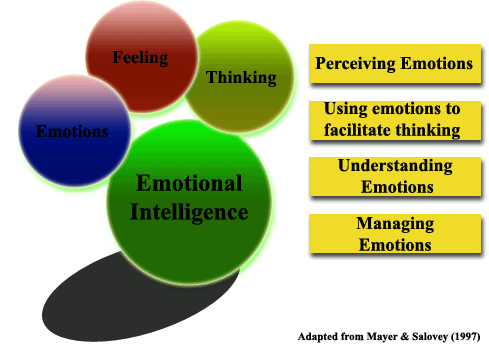
Leadership is Emotional, and Emotional intelligence theory and Leadership go hand in hand. – but first, some quotes:Emotional Intelligence – “is the ability to monitor one’s own and other’s emotions, to discriminate among them, and to use the information to guide one’s thinking and actions” (Salovey & Mayer 1990).
“Emotional Intelligence is a way of recognising, understanding, and choosing how we think, feel, and act. It shapes our interactions with others and our understanding of ourselves. It defines how and what we learn; it allows us to set priorities; it determines the majority of our daily actions. Research suggests it is responsible for as much as 80% of the “success” in our lives” (Freedman et al).
What makes a good Leader?
You may think of an excelling leader as someone who has a calm assuring demeanour and who is in control no matter what the situation. You may also think of someone who has complete trust in all around them; a compassionate listener, always speaking kindly and with clarity; is approachable and always seems to make the right informed decisions.
Effectively, these are all attributes of someone who has high levels of Emotional Intelligence. Referencing Salovey above: the leader is controlling his/her own emotions as well as those of the team to perform excelling results. It is, therefore an extremely important subject – Emotional Intelligence theory and Leadership have a deep embedded relationship that should not be underestimated or overlooked.
What Is Emotional Intelligence Theory?
Often referred to as EI, Emotional intelligence is about having the ability to understand and manage the emotions of yourself and also those around you. Remember, the objective of a leader is to complete the task successfully, keep the team together and manage the team on an individual basis to ensure everyone is happy and playing to their strengths.
Question – Who is more likely to Succeed?
A Manager that shouts and criticises his/her team when under stress?
OR
A Leader that is in control and calmly assesses the situation?
The latter, obviously: the person who is in control of the situation and the surroundings – the one with good Emotional Intelligence!
Emotional Intelligence Theory: The Four Elements
Daniel Goleman, (2002), A psychologist who helped make the idea of EI popular, presented the concept of Emotional Intelligence as being encapsulated by four elements:
- ►Self Awareness
- ►Self Management
- ►Social Awareness
- ►Social Skills

The theory is simple – The more that you, as a leader, are in control and manage each of these elements, the higher your emotional intelligence!
1. Self-awareness
The first element of Emotional Intelligence theory – Being self aware means that you understand you. – You understand what makes you tick and therefore, your strengths and weaknesses as a person, and a Leader. You can then start to understand why you feel, and what makes you feel. “Is this a good emotion, or should I feel a different way?” If you understand your emotions, you can identify their impact to you and those in your team. It is a path on the road to having humility, which is a much needed facet in Leadership.
2. Self-Management
The second element of Goleman’s Emotional Intelligence theory: – Through being in control of what you say and do, whilst rejecting the temptation to make rushed decisions, you can be in charge of your actions and therefore reducing the chance of compromising your values. Other aspects to nurture in this element are to show and actively apply conscientiousness, trustworthiness, Leading and adapting to change, complete drive to succeed and the initiative to think fast and act creatively and innovatively to solve problems.
3. Social Awareness
The third element of Emotional Intelligence Theory: Social awareness is the ability for a Leader to understand the emotions of the team members around them and to get a good comprehension of their emotional makeup. The ability to treat people according to these emotional reactions is vital. This area is linked to empathy: The ability to understand and see things in other peoples view points, expertise in building and retaining talent, valuing diversity and appreciating the organisational goals. In essence this part of emotional intelligence then, is about understanding and being truly in touch with the complete demands of the environment and acting to suit those conditions.
4. Social Skills
The fifth and final element from Goleman’s emotional intelligence theory, which links Leadership and Emotional Intelligence together: Leaders with good Social Skills are often very good communicators. Leaders who are good in this discipline are also good at conflict resolution and communicating the vision to team members, enlightening them and creating motivation and inspiration throughout the team. They are experts at getting their team to support them and also believe in their leadership. They set the example, for others to follow by demonstrating the acceptable behaviours and values.
Perfection takes practice
Being a great Leader takes time. It is one that can be achieved, and through the use of emotional intelligence Theory and Leadership combined, and following some of the suggestions referred to on this page, your skills can be increased.
Focus on these four elements of emotional intelligence theory, and with practice, you will improve. Keep doing it, and you will improve further. Repetition is the mother of skill!
How to improve your Emotional Intelligence:
A daily journal – Journals help improve your self-awareness. Writing down your thoughts can move you to a higher degree of self-awareness. Understand what you did, why, how did it make you feel/ act? What did you do well? What could you improve on? Just reflecting on this everyday, will enhance your Self awareness and personal improving routine.
Calm! – Running one hundred miles an hour can be a blur – SLOW DOWN at times, and when strong emotions rise through demanding situations, use the three second rule – Pause, count to three and then ask why. Why are you feeling angry? What can you do to counter this? An emotion is a state of mind – how can you convert anger to a more positive emotion? What can you learn from this situation? No matter what the situation, you can always choose how you react to it.
Understand your values – Take time to understand what you believe in and what your values are. Understand your driving values: things that get you going and that create ambition. Also, list those values that are your ‘away from’ values: those that cause you to avoid things because of fear. Spend some time to understand your high valued principles as well. These are important values and principles that you do not want to compromise. If you know what is important to you, decisions will be easier to take – ones which do not compromise your values.
Be Accountable for your actions – Remember, you have a choice in everything you do. If you don’t already, take accountability for your actions and decisions. If you make a bad decision, learn from it, but face the music and take responsibility for it. You gain respect if you do and with respect comes great Leadership.
Re-examine why you’re a Leader – When times get tough, it is fairly easy to forget what you really love about your career. You must take some time to remember why you wanted this job and what your long term vision is. Try to remind yourself daily where you are, where you want to be and how you will get there. If you are still unhappy try to get to the root cause to understand why. Once you highlight this, you can then act to do something about it.
Goals – For every one of your goals, write down the reasons why you absolutely want to achieve them! These reasons will give you motivation when times are hard.
Turn negative situations into positives – Every time things are difficult, ask yourself, “What can I learn from this?” Is there anything that you can take away and introduce so the situation doesn’t happen again? Write your learning points in your journal.
Learn and understand conflict resolution – Leaders must know how to resolve conflicts between their team members, customers, or vendors. Learning this skills is imperative if you want to succeed as a leader.
Learn how to praise others – As a leader, you can inspire the loyalty of your team simply by giving praise when it’s earned. Learning how to effectively praise others is a fine art, but well worth the effort. Remember that journal – record your actions, review it daily and polish your skills!
Other Related Articles:
What Other Visitors Have Said
A Second Chance
My professional career — 18 years and counting in the USAF — was established from a single failure. In the Spring of 1996 I failed a mandatory block …
The Smoke behind the Fire
In this lesson and reading many examples of what separate leadership vs manager I want to share several traits that I believe is essential to be being …