
How Do You Define Leadership?
Key Terms
- Leadership (definition)
- A process through which an individual influences a group of individuals to achieve a common goal — by providing direction, inspiring commitment, building capability, and maintaining the relationships necessary for collective performance. Leadership is a process, not a position; a behaviour, not a title.
The distinction matters practically. Managers receive authority from their organisation; leaders earn influence from their followers. An individual can hold the title of manager without leading — and can exercise genuine leadership without formal authority. In today’s organisations, the most impactful contributors understand both dimensions.
What Are the Three Core Tasks of a Leader?
John Adair’s Action-Centred Leadership model (1973) remains one of the most practically useful frameworks for defining what leaders actually do. It identifies three interdependent tasks that effective leaders must balance simultaneously:
- ►Achieve the Task — Define the goal, plan the work, allocate resources, monitor progress, and deliver the result.
- ►Build the Team — Develop cohesion, morale, and collective capability. Manage conflict. Create a culture where people perform together better than individually.
- ►Develop the Individual — Understand each person’s needs, strengths, and development goals. Coach, stretch, and support individual growth.
The three circles overlap: neglecting any one damages the other two. A leader obsessed with task at the expense of team and individual will see short-term results followed by burnout, disengagement, and turnover.
What Makes Someone an Effective Leader?
Five decades of leadership research consistently identifies the following as predictive of leadership effectiveness:
- ►Emotional Intelligence — Self-awareness, self-management, empathy, and relationship management
- ►Vision and strategic thinking — The ability to see beyond the immediate and set a compelling direction
- ►Adaptability — Adjusting style and approach to the demands of each situation
- ►Integrity — Consistency between stated values and actual behaviour, which generates trust
- ►Communication — The ability to convey vision, give feedback, listen deeply, and adjust to the audience
Explore Leadership in Depth
- ►Leadership Definitions: What the Experts Say
- ►Six Leadership Styles: Choosing the Right Approach
- ►Situational Leadership: Adapting to Your Team
- ►Transformational Leadership: Leading Through Vision
- ►Emotional Intelligence: The Core Leadership Competency
The following section contains our original guide to defining leadership.
There are many ways to define leadership, but in essence, it “is a process that influences other people to achieve an objective.”Now that’s out of the way, let’s see what that really means.
It is about being forward looking, Inspirational to others, and orientated to achieve results, winning the hearts and minds of those followers to achieve objectives and corporate goals, as a team.
When you define Leadership, it is clear that Leaders and their teams are interdependent – They rely on each other for success.
The Leader has arguably three main tasks:
- ►To achieve their goal that they have set out to achieve
- ►To maintain effective relationships with their team members and to keep them together in order to achieve that task
- ►To satisfy the needs of individuals in that group in order to match them to the group task
– The net result: improved and honed Leadership Characteristics, which result in polished and developed Leadership Styles.
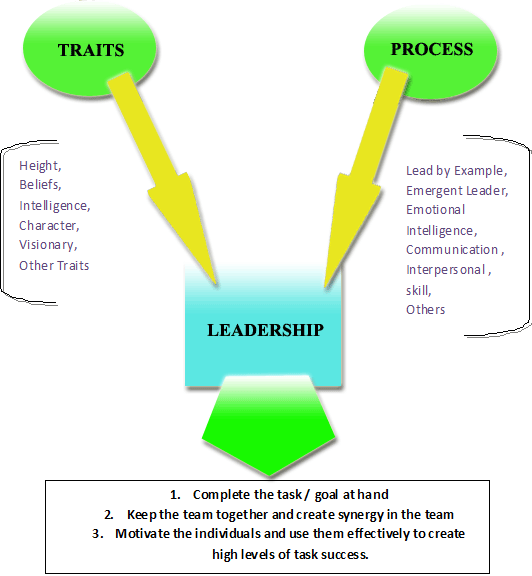
Whilst Leadership can be learned and the skills and attributes can be influenced by the Leader’s traits, knowledge and skills give the Leader the ability and directly influence the process of Leadership.
Management and Leadership
Leadership is the core of all Managerial and Supervisory activities. All those who are in Managerial positions have a Leadership function, and all those in Leadership roles have Managerial responsibilities. Typical roles may include:
- ►To give vision
- ►To energise and motivate
- ►To set and enforce behaviours and standards
- ►To see things through to their completion
- ►To utilise the team member’s skills and get the best out of them, filling capability gaps when needed.
Leadership differs to being the boss or Manager, in that it makes the followers want to achieve high goals (called Emergent Leadership), rather than simply bossing people around (Rowe, 2007).
To define Leadership means to understand that it is not enough for someone to just lead – They must Lead by example, focus on the task at hand, and be truly emotionally intelligent, to get the best out of their team, themselves and the task.
Often, you become assigned a Leadership position, but the best Leaders are good at getting unsurpassed results out of their team through inspirational leadership, which is learned over a career.
Leadership Self-Assessment: Four Diagnostic Questions
Defining leadership is useful. Applying that definition to honestly assess one’s own leadership is where the real development work begins. Four diagnostic questions help leaders identify where their greatest development opportunities lie:
1. Do the people I lead know what direction we are going and why it matters? If the answer is uncertain, the leader’s direction-setting function is underdeveloped. This is not about whether the leader knows the direction — it is about whether the people who need to act on it understand it clearly enough to make good decisions without constant supervision.
2. Do people bring me their real problems, or only the ones they think I want to hear? Psychological safety — the belief that it is safe to speak up with problems, ideas, and disagreements — is a direct function of leadership behaviour. Leaders who react defensively to bad news, punish dissent, or signal that only positive news is welcome will receive only positive news, until a problem becomes a crisis.
3. Am I developing the people around me, or creating dependence on me? The measure of a leader’s long-term impact is not what they personally achieve, but what the people they have led go on to achieve. Leaders who retain decision-making authority rather than delegating it, who solve problems rather than developing problem-solvers, may deliver short-term results while creating an organisation that is fragile, underdeveloped, and dependent.
4. Does my behaviour match my stated values? Credibility — the foundation of leadership influence — is built through consistency between stated values and observable behaviour over time. A single visible inconsistency between what a leader says and what they do is sufficient to undermine months of credibility-building. Leaders are watched more closely than they typically realise, and the signals sent by their behaviour are amplified through the organisation.
Other Related Articles:
Need Further Help?
Performance Coaching – Louise Yates delivers leadership and performance coaching to take your business to the next level