
What Is the 5 Step Problem Solving Approach?
Key Terms
- The 5 Step Problem Solving Approach
- A structured, cyclical method for identifying, analysing, and eliminating the root causes of business problems. The five steps — Define, Plan, Hypothesise, Test, and Measure — guide teams from a clear problem statement through to verified resolution, ensuring that fixes address causes rather than symptoms.
Problem solving is one of the most economically valuable skills in any organisation. McKinsey research estimates that knowledge workers spend nearly 20% of their working week handling issues that stem from inadequate processes or unresolved recurring problems. The cost is not just time — it compounds through scrap, rework, customer dissatisfaction, and leadership distraction.
The 5 Step Problem Solving Approach is particularly effective in manufacturing, operations, and service improvement contexts because it is fast to learn, easy to apply without specialist training, and can be embedded as a team habit rather than reserved for formal improvement projects. It is a practical alternative to more complex methodologies like Six Sigma DMAIC, suitable for frontline teams and everyday operational issues.
When Should You Use the 5 Step Problem Solving Approach?
This approach works best when:
- ►The problem is recurring — it keeps coming back because the root cause has never been properly identified
- ►The team is close to the problem — they have direct knowledge of the process and can observe it directly
- ►A quick, practical solution is needed without the overhead of a full DMAIC or A3 project
- ►You want to build a problem-solving culture by making structured thinking a daily team habit
It is less suitable for highly complex, multi-variable problems that span multiple processes or departments — for those, consider the A3 Problem Solving methodology or a full process improvement cycle.
The 5 Steps Explained in Depth
Step 1: Define the Problem Precisely
The most common failure in problem solving is starting with a vague or incorrectly framed problem. A well-defined problem is already half-solved. Use the following discipline when defining your problem:
- ►What is the deviation from standard? Be specific — not “quality is poor” but “12% of units from Line 3 fail the dimensional check on the third shift.”
- ►When does it occur? Is it constant or intermittent? Is there a time pattern?
- ►Where in the process does it appear? At which step, machine, or location?
- ►How often / how much? Quantity, frequency, and cost establish the business case for solving it.
- ►What is the impact? On the customer, the next process step, cost, or safety.
A structured problem statement might read: “Defect X occurs at a rate of Y on Process Z during Shift 3, resulting in £N of rework per week. Target: reduce to zero within 30 days.”
Step 2: Develop a Problem-Solving Plan
Before investigating, map out at least 2–3 different investigative strategies. This prevents the common trap of immediately jumping to the most obvious cause — which is rarely the actual root cause. Ask:
- ►What data do we need, and where can we get it?
- ►Who needs to be involved? (Frontline operators often know more than managers.)
- ►What tools will we use? (Fishbone diagrams, 5 Whys, Pareto charts, process mapping?)
- ►What is the timeline and who owns each action?
Step 3: Generate and Evaluate Hypotheses
Review your investigative strategies from Step 2 and select the one most likely to reveal the root cause based on available evidence. A hypothesis is not a guess — it is an educated proposition based on data, process knowledge, and pattern recognition.
Good hypotheses are specific and testable: “We believe the defect is caused by temperature variation in the curing oven during the third shift, because the night shift data shows a correlation between ambient temperature drops and defect rates.”
Prioritise hypotheses using impact and testability: test the most likely and most easily verified causes first.
Step 4: Test Your Hypothesis
Implement the chosen investigative strategy and gather evidence. This stage requires discipline:
- ►Change only one variable at a time when testing, otherwise you cannot isolate the cause.
- ►Document observations systematically. Anecdotal evidence is not sufficient.
- ►Involve the people closest to the process — they will spot nuances that are invisible in data alone.
- ►If the hypothesis is not confirmed, return to Step 2 and select the next strategy. A negative result is still progress.
When root cause is confirmed, implement a countermeasure — a targeted action that directly addresses the identified cause. Distinguish between immediate countermeasures (containing the impact now) and permanent countermeasures (preventing recurrence).
Step 5: Measure and Standardise
Measurement closes the loop and is the step most frequently skipped. Without it, you cannot know whether the problem has genuinely been resolved or merely suppressed temporarily. Measure:
- ►The original metric — Has defect rate, downtime, or error frequency returned to standard?
- ►Over sufficient time — A single good data point proves nothing. Measure across at least 2–3 cycles or shifts.
- ►The process, not just the output — Confirm that the countermeasure is being applied consistently.
Once the problem is confirmed resolved, standardise the solution: update work instructions, retrain operators, and add the problem and fix to your organisational learning records. This is how a problem-solving culture actually reduces the total number of problems over time.
How Does the 5 Step Approach Compare to PDCA and A3?
| Method | Steps | Best For | Complexity |
|---|---|---|---|
| 5 Step | 5 | Frontline operational issues, team habits | Low |
| PDCA | 4 | Iterative improvement cycles, small experiments | Low–Medium |
| A3 | 8 | Cross-functional problems, manager-led analysis | Medium |
| DMAIC (Six Sigma) | 5 | Statistical process problems, significant variation | High |
Common Mistakes When Using the 5 Step Problem Solving Approach
- ►Jumping to solutions in Step 1 — Defining a problem as “we need to retrain operators” is a solution, not a problem statement. Define the deviation first; identify causes after investigation.
- ►Testing multiple changes simultaneously — Makes it impossible to know which change fixed the problem (or made it worse).
- ►Stopping after symptoms improve — The problem feels “solved” but the root cause remains. Measure long enough to be certain.
- ►Not involving frontline teams — The people doing the work have knowledge that no manager or data analyst has. Their involvement in Steps 2–4 dramatically increases solution accuracy.
- ►Skipping standardisation — Without updating procedures, the same problem recurs when staff change or processes drift.
Related Problem Solving and Process Improvement Resources
- ►5 Whys Root Cause Analysis: How to Find the Real Problem
- ►Fishbone Diagram (Ishikawa): Mapping Cause and Effect
- ►A3 Problem Solving: The Toyota Structured Approach
- ►Plan Do Check Act (PDCA): The Improvement Cycle Explained
- ►5 Business Process Improvement Steps
The following section contains our original introduction to the 5 Step Problem Solving Approach.
The 5 Step problem solving approach assists in the identification and elimination of root causes to problems, but what is a problem?A problem is a deviation from the standard. It is something that wasn’t expected and could be something like, poor on time delivery, poor quality, taking too long in the process, poor information flow, re-entering data in a spreadsheet, correcting a mistake, high internal scrap. It can be absolutely anything that creates an output that is not to plan.
Again, the art of being competitive in business is how quickly you can use problem solving strategies as an embedded culture, to find problems at source and eliminate them.
An alternative to PDCA, the 5 step approach is a simpler alternative, which may help a team quickly understand and try new ideas to resolve the problem at hand.
One way of solving problems is this five step method:
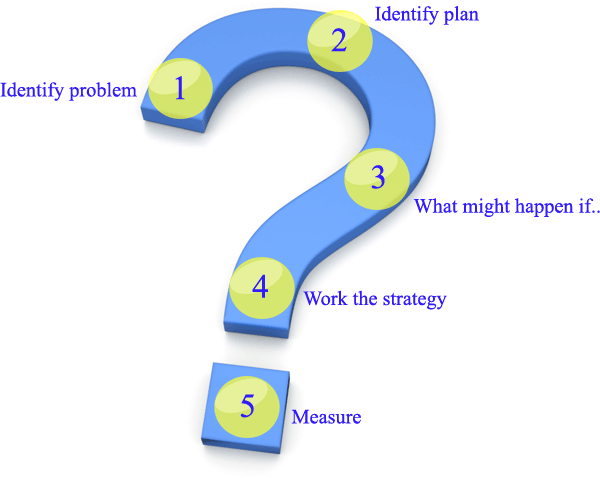
1.What is the problem?
The first stage of the 5 step problem solving model – Define exactly what the problem is.
Be clear and specific as to what exactly the problem is, when it happens, how often, what effect is it, what is the deviation from standard? See Problem statement for more information.
2. What is my plan?
Think of at least 2 or 3 possible methods that you might use to identify what went wrong. In other words, where and what do you need to investigate to help determine the cause. A strategy is a way or method or process for understanding the root causes.
3. What might happen if?
Examine your list of possible strategies from section 2, and choose the one that seems to fit best for the problem at hand.
4. Try it out!
Work the strategy, which you chose in step 3 and determine whether your team found the cause. If you did, then move onto the next step.
5. Measure
Measure the process outputs, and if the problem has gone, you are done!
If your best strategy doesn’t work, go back to your list of possible strategies in Step Two and choose another. Keep passing through the steps until your measurements tell you the problem has gone.