
What Is the Difference Between Leadership and Management?
Key Terms
- Leadership vs Management
- Leadership and management are distinct but complementary functions. Leadership is the process of influencing people toward a shared vision — setting direction, inspiring commitment, and driving change. Management is the process of organising resources, planning activities, and controlling outcomes to achieve defined goals. Most organisations need both, and most effective leaders must be capable of both.
Peter Drucker captured the distinction concisely: “Management is doing things right; leadership is doing the right things.” Warren Bennis extended this: “Managers are people who do things right and leaders are people who do the right thing.” The practical implication is that a technically excellent manager who optimises an organisation for the wrong strategic direction is both efficient and ineffective simultaneously.
Leadership vs Management: A Detailed Comparison
| Dimension | Leadership | Management |
|---|---|---|
| Primary focus | Direction, vision, inspiration | Planning, organising, controlling |
| Orientation | Future-focused; asks “what should we do?” | Present-focused; asks “how do we do this well?” |
| Change stance | Drives and embraces change | Manages and stabilises change |
| Power source | Influence, trust, vision | Authority, process, position |
| People approach | Develops, inspires, coaches | Directs, coordinates, appraises |
| Risk relationship | Accepts calculated risk for breakthrough | Manages and mitigates risk |
| Success measure | Follower growth, culture, direction | Output, efficiency, compliance |
Why Organisations Need Both — Not One or the Other
The leadership vs management debate is often framed as a hierarchy, with leadership positioned as superior. This is a damaging simplification. An organisation of visionary leaders without effective management processes becomes chaotic — full of inspired people working inefficiently in different directions. An organisation of excellent managers without effective leadership becomes over-controlled, risk-averse, and unable to navigate strategic change.
The most effective organisations — and the most effective individuals in them — develop both capabilities: the ability to set and inspire direction (leadership) and the ability to organise and execute reliably (management).
Related Leadership and Management Resources
- ►Six Leadership Styles: The Complete Manager’s Guide
- ►Transformational Leadership: Leading Through Vision
- ►Setting SMART Goals: Bridging Leadership and Management
- ►Emotional Intelligence: The Foundation of Both Roles
🔗 Related: Effective Leadership Styles: Style Choices for Leaders
The following section contains our original exploration of the leadership versus management debate.
Leadership versus management, isn’t it the same thing?
Nope!
Leaders set goals and direction, challenging the norm, and seeking new ways of working towards goals.
Managers on the other hand maintain the status quo.
They specialise on conformance to the standard.
They manage their teams and individuals.
And they organise, direct and control to achieve goals.
The Paradox
Leadership versus management, although relatively easy to distinguish between the two, is complex because many people are both. The Manager has the unfortunate paradox of controlling systems, resource and standards.
They have to ensure that everywith works to plan and that all is in order. But it doesn’t stop their. They have to also lead teams to achieve unchartered boundaries and new ways of working.
If you think about it and based on theories of Leadership, dictating through an autocratic management style will not win the hearts and minds of individuals. This in turn will create more damage than good for the long term, so Leadership plays an important role in leading and motivating the teams to achieve new things.
Management normally focuses on work and tasks. These activities fit within the subject of resource: Human, time, Money, and equipment, including:
- ►Planning – Planning resource and tasks to achieve the objectives
- ►Budgeting – Managing the constraints of budgets in the department / project
- ►Organising – Organising support functions and resource
- ►Controlling – Controlling the standards required to deliver the objectives
- ►Coordinating – Coordinating and directing project tasks for achievement of goals
- ►Resource use – Ensuring effective resource is used for the task at hand
- ►Time management – Ensuring tasks and activities are conducted within the correct time frame
- ►Decision Making – Making the right decisions in the heat of the moment
- ►Problem Solving – Ensure problems are contained and eliminated
Leadership
Leadership focuses on achieving nice shiny goals, keeping the team motivated and empowered to achieve as much as they can.
It’s also about getting the best out of each individual for the benefit of the team.
It’s about leading by example, inspiring, empowerment.
It’s about creating the most conducive environment for team success:
- ►Vision– focusing on the long term vision or goal
- ►Motivation – Motivation and empowerment to challenge the norm
- ►Inspiration – Inspiring others through merely leading and injecting enthusiasm
- ►Persuasion – Using excellent leadership skills to bring people willingly along the correct path
- ►Team work – Encouraging effort and commitment, and teamwork
- ►Building Relationships – Building strong relationships and ensuring the team is well balanced
- ►Listening – Being able to listen and get the root causes quickly and effectively
- ►Counselling – Ensuring that every member of the team is motivated and effectively empowered
- ►Coaching – Encouraging and giving freedom for individuals to learn and grow
- ►Teaching – Leading the correct performance and expectations
- ►Mentoring – Being the leader in a successful team and parting knowledge and wisdom onto the team and its individuals
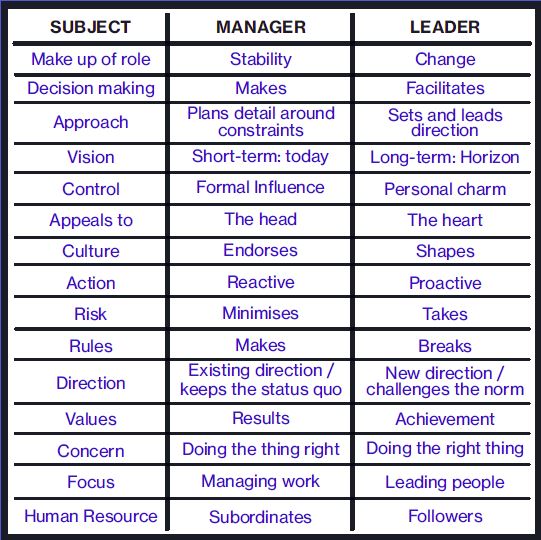
Leadership versus management table to compare the two
The bottom line is; as a leader / manager, you must adopt both stances.
Sometimes you may have to ensure that performance is to plan (managing goals). And other times, you may need to set knew goals and inspire new ways of thinking.
Unfortunately, it is not either / or; it’s both.
Those that think it’s an either / or, will hamper the development and motivation of the team:
- ►Lead too much, with little standards, and you risk a rule of chaos and little discipline.
- ►Manage too much and you stifle morale by being an authoritarian manager.
If you think you’re just a manager, then chances are you are missing a load of opportunity to achieve new heights of team success. Also, if this is you, spend some time finding out what your employees think of you and how they feel in their roles.
Chances are, they may not be that impressed.
On the other end of the spectrum, if you think you are just a leader, then there may be some things you may be missing out on, and that could be structure and systems to support the team.
If you lack management skills, then you may be seen as too informal and off the hoof in decision making. You may not have a handle on the things that keep the team and business moving forward.
The bottom line is that you need to mix both up. The best leaders and managers are interchangeable. Often though, too many are either / or. They mis vital tasks to really drive team success.
Where are you? Take note of each line item in the diagram above, and identify where you need to improve and when and begin to take action.
Get 4 Valuable Management Guides in One, For FREE!
Download your Free Ebook and 4-kit Management Guides to help you learn more about team building, assess your current management skills, practice time management and explore leadership best practices.
Packed with the following free guides:
- ►17 Team Building Ideas
- ►Self-Audit: Are You a Micromanager?
- ►Best Practices Leadership
- ►10 Time Management Tips

Download Your 4-Kit Management Guides For Free, Now!
Return from Leadership versus Management to Leadership Home Page